Showing posts with label Short Stories. Show all posts

10 Apr 2011

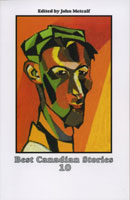
Best Canadian Stories 10

10: Best Canadian Storiesedited by John Metcalf ~ Oberon Press
  ~ Review: Halifax Herald, March 2011

“Mavis Gallant said that the one question to ask of a story, a book, a painting or a building is: ‘Is it alive or dead?’ Check this year’s vital signs,” writes John Metcalf  in the introduction to Best Canadian Stories 10.   Metcalf is right of course. Oberon’s 2010 short story collection speaks for itself.  These stories overflow with life and living and once again, Metcalf shows his ability to find the best.

Hold Me Now (Stephen Gauer) tells the story of a father who is given the shocking news that his son has been murdered.  As he attempts to make sense of it all, his life becomes linked with that of Curtis, his son’s underage killer.  Gauer’s understated tension through the ensuing trial and the events that follow is masterful. Anna (A Small Haunting by Shaena Lambert) begins to think she is quietly going mad when she finds her house is haunted by a small child. And Maude befriends a strange young girl called Kreetch (Daytrip by Patricia Young) who arrives at the library every day after school.   The gentle tenderness of Young’s story is the perfect opening to this year’s collection.

Oberon’s commitment to providing a platform for new and emerging short story writers in Canada is laudable, and this year’s collection stands with the best. Bring on Best Canadian Stories 11!

John Metcalf is a well-known Canadian author and editor.  He immigrated to Montreal from the UK as a young man.  He has been editing this collection for Oberon for many years, in the company of authors such as David Helwig and Joan Harcourt.  He lives in Ottawa.

Granta: Going Back

Granta: Going Back
Edited by John Freeman 
House of Anansi Press
  ~ Review: Halifax Herald, February 2011 

Short stories are often the first thing new writers publish.  They go in and out of popularity, and finding a home for that first story can be difficult.  Since it’s makeover in the 1970's, Granta has played a significant role in providing a market for new writers and artists, publishing short stories, photojournalism, poetry, biographies, indeed anything that is able to loosely fit within its pages.  It is indeed “The Magazine of New Writing”.

Going Back is a ‘themed’ issue based somewhat loosely on “what happens after we go back”. It diverges from Granta’s norm in that the writers and artists are well established. Editor John Freeman has put together a splendid collection of stories, poetry, art and photography about loss, memories, joy and finding the ability to let go. 

Janine di Giovanni’s The Book of the Dead brings into sharp focus the human spirit’s ability of to survive under seemingly impossible conditions of deprivation and loss during the war in Sarajevo.  Ian Teh’s stark photography of industrial China (Traces: China 1999 - 2010) speaks volumes and Missing Out by Leila Aboulela tells the story of the collision of cultural values within a marriage.  Elizabeth McCracken’s Property shows the heart of a young widower as he struggles with his loss.

There is a previously unpublished excerpt from Mark Twain’s diaries, and a series of letters written over 30 years by Iris Murdoch to French writer Raymond Queneau. (It is believed that she destroyed his letters to her.)  It is tricky to find a favourite amidst such talent.

Since its inception in Cambridge, UK, in 1889, Granta has published the works of writers such as A. A. Milne, Doris Lessing, Ian McEwan, Gabriel Garcia Marquez, Arundhati Roy and Sylvia Plath. It was rescued from oblivion in the 1970s, and the rest, as they say, is history.

2 Mar 2011

Message from an Unknown Chinese Mother

by Xinran
Random House
  ~ Review in Halifax Herald, August 2010

Between 1966 and 1979, Chinas population almost doubled in size to a staggering 1.2 billion people.  Feeding this exploding population was an enormous challenge and, in an attempt to curb the escalating numbers, the “one family, one child” policy was instituted.  The consequences of this legislation have been cataclysmic for girl babies within a culture where male babies were already valued more highly, and for their mothers, especially those born into poorer, village families. Tradition dictated that “ ... the first surviving child had to be a boy or their lives would be blighted and they would not go to heaven.”

Xinrans new book, Message from an Unknown Chinese Mother: Stories of Loss and Love,
documents the harshness of obedience and the heartache of mothers forced to give up their baby daughters, to orphanages if they were lucky or to death if they were not.

This collection of ten firsthand stories is hard to read and even harder to understand within the cultural context of a country struggling out of feudalism and catapulting into the 21st century. 
Villagers were “... torn between the enlightened standards of modern civilization and the cruelty of ancient traditions, where human feelings could lose their way.”

Xinran began her career on a radio show in China, giving a voice to women.  Message from an Unknown Chinese Mother focuses on the mothers who have lost their daughters. These babies may be lost from their mothers forever, adopted in the West, abandoned or even killed, but they are never forgotten.  “Chinese women lived on the bottom rung of society, unquestioning obedience was expected of them and they had no means of building lives of their own.”  But within the hearts of the mothers who bore them, these daughters are remembered and loved.  These are the stories of the Chinese mothers who saved their girls when they could and the message they send to their lost children is clear - perhaps we could not keep you, but you are mourned and always loved.

Xinran is a journalist and author. In 1997, she emigrated from China to England with her son.  She founded The Mothers Bridge of Love, a charity established to help disadvantaged Chinese children.  This is her sixth book.

Loose Pearls & Other Stories

[pearls-web.jpg]by D.C. Troicuk
Cape Breton University Press
  ~ Review in Halifax Herald, June 2010

This first collection of stories from D. C. Troicuk are quietly understated as life flows gently below the surface of daily life. Family cold wars are buried deep, and sometimes the glue holding things together, no matter what, is tainted by dislikes and resentments, bound inextricably by duty. The boiling point is not an explosion but rather an understanding that takes hold, a clarity of vision which builds until somehow, mostly, characters see the reality of their truths.

Wendy brings home strays, young men who remind her of Billy, her brother who vanished many years ago.  We never know why, but we know that Wendy never stops searching.  An underlying sense of responsibility causes her to forgive transgressions and overlook the obvious, maintaining a code of silence, even when it is clear that she must become complicit in a crime.

In Katia Suffers, Katias life has become bound to the service of others.  She cooks and cleans for her husband and cares for her hypochondriac sister with a “…high tolerance for the list of maladies Vera collects from womens magazines…”  But she lies awake at night, casting wishes like nets."

A young girl finds out she is pregnant.  A pervert’s victim cowers indoors. “I am the proud owner of a newly renovated deck where I cannot sit, a lawn I cannot mow, a garden that that has become a bug buffet.”  Her pivotal moment is when she realizes she is not powerless.

Troicuk is an excellent teller of tales.  She writes with a clarity of vision that brings focus to her stories, and the setting and her characters speak to the rich flavour of Cape Breton Island, without drifting toward folksy.  These stories are simply Cape Breton.

Troicuks first book, Loose Pearls, is triumphant, and surely an indication of things to come. The good news is that her next book, a novel, is already in progress.

D.C. Troicuk lives and works in Cape Breton. Her work has appeared in several journals, including the Antigonish Review, the Pottersfield Portfolio and Canadian Living.  This is her first book.  

Day out of Days

From the Trade Paperback edition by Sam Shepard
Knopf Canada
  ~ Review in Halifax Herald, April 2010

On the surface, Sam Shepards latest collection of short stories is a road trip.  But just on the surface. Dig a little deeper. These stories dont follow any traditional route.  They wander from town to town, and are sometimes surreal, sometimes touching, often macabre.  Some are very short, some not so much.  There are random fragments, rants, the occasional monologue, some poetry, and stories from the past.  Stories from the heart.  They yearn and plead.  But always they are searching, wanting, looking for perspective as age gathers in, for a reason for it all.  Looking for peace.

Occasionally, there is a story that is downright creepy, although strangely, not the one about the severed head lying in a ditch begging a passerby to take him to a lake (Haskell, Arkansas: Highway 70). Far from it. When the man refuses and passes by, “the head calls out to him in the most forlorn and melancholy voice the man has ever heard.”  The man returns.  “Do you think you could open your eyes for me? Just once?” asks the man.  “No”, says the head, without hesitation.  “... you wouldnt be able to take it.”  They strike a deal, the man and the head, and they set out together through several stories.

Shepards writing is compelling.  With the artistry of a craftsman, he drags his readers in and holds them, page after page. Staccato sentences mark his aggressive, hard-edged style.  Land of the Living is a marriage in limbo, partners lost from each other, familiarity and children holding the threads together on the family vacation. “We behaved decently ... remembering the days we were seldom out of each others sight and had no reason to doubt we would be forever in love.”

Shepard takes us to the Krispy Glaze donut shop of his youth, to Las Vegas, to Knoxville, Tennessee, through a whiteout in Wichita, Kansas where traffic is stopped dead. “Thank God for Guy Clark on my satellite radio.”  But in Gracias, the small, touching finale, Shepard gives his final gift and lets his readers close the book with a soft smile. Perfect!

Sam Shepard is a Pulitzer Prize-winning playwright, author and actor. His books have won many awards, and he has acted in more that thirty movies, receiving an Oscar nomination for The Right Stuff.  He lives in New York and Kentucky.

In Other Rooms, Other Wonders

by Daniyal Mueenuddin
W.W. Norton & CompanyI
  ~ Review in Halifax Herald, February 2009

In this linked collection of stories, Daniyal Mueenuddin gives us a private viewing into parallel worlds of great wealth and great poverty, and the corruption and thievery that is intrinsic to both.

K. K. Harouni is a feudal landowner whose favours to those  dependent on him are dispensed generously and thoughtlessly.  They are withdrawn just as easily, with sometimes calamitous results.  But his wealth is old money, and times are changing in Pakistan.  These stories tell of Harouni’s household, his family and staff, and the villagers who depend on him for their survival.

In A Spoiled Man, Rezak has been cast out by his family. When a servant intercedes on his behalf, he is hired to ensure the American wife’s orchard is kept watered. He cannot believe his fortune. He is happy - until he falls victim to events and is powerless to influence the outcome.  This is a theme that repeats itself throughout these stories.

 Saleem becomes involved with Rafik, Harouni’s personal retainer.  Although much older, he provides her safety and she comes to love him dearly.  When his family arrives from his village, honour and tradition win out and Saleem is put aside.  Without protection, ‘within two year, she is finished.’

Mueenuddin’s writing is measured, gentle.  He takes the time to set the stage, making sure that we, his readers, have the background necessary to see the texture, to understand the intricacies of the tapestry unfolding on the page.  His portrayal of corruption and the manipulation it feeds, and the powerlessness of poverty is woven through these stories as rich and poor alike jockey to better position themselves.

What Mueenuddin does very well is put this in context.  He places his characters at the forefront, where they indulge in acts of thoughtless cruelty intertwined within the beauty of kindness and love.  He castes no judgements. This is a wonderful debut collection and presents to us the rich landscape of an ancient, diverse culture that is uneasily changing.

Daniyal Mueenuddin studied law at Yale and worked as a lawyer in New York City. He now manages a farm in Pakistan.  This is his first book.

Mother Superior

Mother Superiorby Saleema Nawaz            
Freehand Books
  ~ Review in Halifax Herald, March 2009

“There is a photograph of me and Kathleen in the rec room with Maggie, our dead baby sister,” begins Nawaz’s award winning short story, My Three Girls. “A picnic pose.”  Their mother never stops grieving and years later refuses to visit her new grandchild.  In Bloodlines, two sisters react to their mother’s death, one ballooning in pregnancy, the other fasting into anorexia “with shoulder blades like axe-heads ready to slice through skin.”

Many of the stories in Nawaz’s collection talk of motherhood, of being a daughter and of loss and untouchable grief. The relationships flow easily on the page, often with understated humour and always with awareness of the complications of families.  Sometimes mothers fail, but never completely.

The White Dress is the story of nine year old Shay, secure and adoring of her adoptive parents.  Until she reads her mother’s notebook which “threatened things, that hinted at something outside our tiny world of three.”  Shay begins to believe that she “was a replacement child, the new hope for the family.”  She is willing to play the role.

Kate’s constant admonition to her mentally disabled brother is Look, But Don’t Touch. She cares for him, staying at home to create a cloak of protection from her mother’s cold disapproval.  Until one day, she forgets to repeat the mantra. “I don’t blame my mother for feeling exasperated.  She probably didn’t expect to have two children who would never leave home.”

My Three Girls won the coveted Journey Prize in 2008 and The White Dress won the Robert Kroetsch Award for Best Creative Thesis at the University of Manitoba. This is a spectacular debut collection by any standard.

Saleema Nawaz lives in Montreal. Her short fiction has appeared in several literary journals, and this is her first book. 

The Butcher of Penetang

by Betsy Trumpener
Butcher Of Penetang - Betsy TrumpenerCaitlin Press
  ~ Review in Halifax Herald, July 2009

In Betsy Trumpener’s own words, The Butcher of Penetang is “a mosaic”, short pieces that somehow interlock into a whole.  The stories in Trumpener’s first collection are sharp and unconventional.  They are short, often less than two pages, and they sometimes lack the beginning/middle/end of the conventional short story.  But these stories burst from the page in language that is succinct and mesmerizing.

A family takes a wagon west in All the Child I ever Had Sleeps Yonder, taking turns to walk because it is too narrow for a family of 10 to travel in. A young woman comforts an accident victim while the policeman apologizes and leaves for a meeting. In Needle Exchange, a child goes missing in a dangerous part of town. And a mother, trying to protect her baby from a weasel, calls the government but “they were too busy laughing to help”.

Trumpener’s stories are set in western Canada and tell of hardships and grief, of small joys and triumphs as people, often immigrants, struggle to make a life for themselves and their children.  Trumpener picks tiny moments and translates them onto the page with a vividness and intensity that makes this a remarkable debut collection.

Betsy Trumpener is a short story writer and journalist with CBC Radio. Her stories have been performed on radio, and published in magazines and anthologies.  The Butcher of Penetang is her first book. She lives in Prince George, BC.

Going Ashore

by Mavis Gallant
McClelland & Stewart
  ~ Review in Halifax Herald, August 2009

When Mavis Gallant submitted her last book to her publisher in 1996, some stories had to be cut to reduce the book to a manageable 887 pages.  Luckily for her readers, McClelland & Stewart’s solution was simply to make another book, and just in time for summer! This new collection spans more than thirty years and includes some satirical essays and stories that have been out of print for years, or never before published in book form.

In Autumn Day (1956), a young woman moves to post-war Salzburg with her army husband.  She is nineteen, friendless, away from home for the first time and married to a man she is not even sure she likes.  Gallant captures her essence perfectly.  We sympathize with her while being exasperated at the little girl in her.  As she stumbles into adulthood “she wondered if all of this - my crying, Walt being bewildered - was married life, not just the preliminary.”  

And all sympathy for Louise’s lover in The Cost of Living is lost in a few words.  “Patrick, my sister’s lover.  Well, perhaps, but not for long.  An epidemic of grippe came into the city, as it did every year, and Patrick was instantly felled.”

This is not a book of ‘left over’ short stories. Selecting between any pieces of Gallant’s must have been truly difficult.  She writes with such clarity and her understanding of our inner feelings, especially those we think are well hidden, is extraordinary.  Her ability to translate this onto the page is what makes her a great writer.

A Revised Guide to Paris (1980) is a short, satirical masterpiece. “Dusk, one of the few institutions not yet under the management of Social Security.”  And if you get robbed in Paris? Gallant gives explicit instructions on how to raise bales of cash on the sidewalk, using a piece of chalk and  her carefully worded text. 

Any new book of short stories from Mavis Gallant is an event to be celebrated.  Going Ashore does not disappoint. 

Mavis Gallant was born in Montreal, and worked there as a journalist before moving to France in 1950 to write.  Her short stories are widely published.  She won the Governor General’s award in 1982 and the Order of Canada in 1993.  She continues to live in Paris.

Buying Cigarettes for the Dog

by Stuart Ross
Freehand Press
   ~ Review in Halifax Herald, September 2009

Stuart Ross has an interesting take on the world.  Buying Cigarettes for the Dog, his latest collection of off-beat stories, have a tendency to veer into the surreal. His themes, though, are usually clear. The stupidity of war.  The ability (or inability) to communicate.  How we do or don’t cope with life. His stories are strange and mesmerizing. 

Ross doesn’t waste words.  Some of his stories are only four to six pages, snappy even for a short story. His often dark humour resounds through the collection.  ‘Language Lessons with Simon and Marie’ instructs those with “faltering English” how to “engage in sophisticated repartee at University Gatherings, Diplomatic Functions and other Social Opportunities.”  Perfect English, but please don’t try this in company!  In the title story, Buying Cigarettes for the Dog, a husband tells his wife he’s going for smokes and returns home some years later to find strangers living in his house.  He is puzzled.

Reading these stories is like watching Ross poke at life with a sharp stick, wondering what will turn up.  While not to everyone’s taste, they are strangely compelling, resonating long after the last page has been turned.

Stuart Ross is a poet, novelist, essayist and anthologist who published his first literary pamphlet on a photocopier in his dad’s office in 1979.  He lives in Ontario.

Reasons for and Advantages of Breathing

by Lydia Peelle
Harper Perennial
  ~ Review in Halifax Herald, September 2009

The introduction of tractors revolutionized farming methods.  Life got easier and production increased. Mules were no longer needed to haul great loads of firewood, move boulders or plow the fields. The opening story of Lydia Peelle’s first book of fiction, Mule Killers, tells of the year the mules were trucked away, “sleek and fat on oats, work-shod and in their prime.”  The year of the International Harvester marked the end of Orphan Lad, Willy Boy, Champ, Kate and Sue.

Sweethearts of the Rodeo is a coming of age story. The narrator and her friend spend the summer working with horses, taking chances and living wild. “Our bodies forgive us our risks,” she says, “and the ponies do, too.  We have perfected the art of falling.”

“I meet the herpetologist on the bus” begins the title story, and an unlikely friendship develops between an elderly herpetologist and a young woman at a turning point in her life.  It is an enchanting and prophetic tale of discovery. In the rooms behind the herpetologist’s office, heated aquariums provide homes for anoles, salamanders and gila monsters.  “All these diverse adaptations, with one common goal,” says the herpetologist. “To live to see tomorrow.”

In her first collection, Peelle shows herself a master of succinctness, those few well chosen words which convey a wealth of meaning.  The prose in Reasons for and Advantages of Breathing is poetic and the stories are diverse and unusual, each one leaving a lingering, pleasurable aftertaste. But eight stories are not enough - we must hope for more.

Lydia Peelle’s short stories have won several awards, including the O. Henry Award.  Reasons for and Advantages of Breathing is her first book.  She lives in Nashville, Tennessee.

Singing for Mrs Pettigrew, Stories and Essays from a Writing Life

by Michael Morpurgo
Candlewick Press
  ~ Review in Halifax Herald, October 2009

Michael Morpurgo is also a teller of stories and it’s easy to see why he held the post of Children’s Laureate in Britain from 2003 to 2005.  The stories in Singing for Mrs Pettigrew speak directly to his chosen audience - children. He revels in the chance “to rediscover and indulge in that delightful and necessary conspiracy in which I suspend all the trials and tribulations I have come to know and share with them for a while the wondrous worlds of . . . Winnie-the-Pooh and Peter Rabbit.”  But whether it be stories for the young and the young at heart or stories of travel and musings, his understanding of the world and of people delightfully entertains.

Singing for Mrs Pettigrew is a collection of stories and essays, interspersed together to make a book of thoughtful book for both children and adults. His essays are sometimes travelogues as he wanders the English countryside, sometimes informative as he tells of Farms for City Children, a hugely successful venture which has given sixty thousand children a farm experience “harvesting, mucking out, feeding sheep and pigs and calves”, and sometimes instructional as he talks about his life as a writer.

Pen and ink sketches by Peter Bailey scatter through the pages, illuminating stories and essays alike.  I looked for a favourite, but found many.  My One and Only Great Escape tells of a young Morpurgo, at boarding school and desperately homesick, making a break for it.  The illustration alone is worth several pages! There is Yannick, a small boy sent to France for the summer holidays, who learns how to make crème brûlé for Picasso.  And there are whales and ghosts, unicorns and giants.

Morpurgo does not shirk from difficult subjects. The Giant’s Necklace is the story of Cherry, a young girl who becomes cut off by the tide while collecting shells.  Her struggle to climb above the rising sea and her encounter with the ghosts of miners long gone gently lead the reader toward an inevitable conclusion.  Masterfully done!

Singing for Mrs Pettigrew is a curl up and read aloud book, or a quiet, easy read-in-a-corner book for all ages. And it loudly speaks to the writers in us all. “Don’t pretend,” writes Morpurgo. “Tell your tale.  Speak with your own voice. We are what we write, I think, even more than we are what we read.”

Michael Morpurgo was the Children’s Laureate of Britain from 2003 to 2005 and has written more than 100 books.  He lives in Devon, England.

Too Much Happiness

by Alice Munro
McClelland & Stewart
  ~ Review in Halifax Herald, October 2009

The London Review of Books is not given to hyperbole, so when their September issue made reference to Alice Munro as “possibly the world’s greatest living writer of short stories”, (London Review of Books, September 2009) one must believe there is a basis of fact.

Munro’s latest collection of short stories, Too Much Happiness, is part of that fact. Her fourteen other books would be the rest. Certainly, the judges of The Man Booker International Prize thought so.

The stories in Too Much Happiness are as good as anything Munro has written.  Perhaps better!  But judge for yourself - read her book.  Even if short stories aren’t your thing, read the book. Perhaps your taste will change.  Perhaps not, but read it anyway. You have nothing to lose and everything to gain. Take your time. Breathe between the stories.  Savour the words, because Munro doesn’t waste them. Sit quietly with the endings for a few minutes.  There’s no special order to the stories so pick a title that appeals and start reading. You won’t be sorry!

It is clear Munro likes her characters.  They have a humanness, which, in spite of their sometimes dire circumstances, asks for and often gets compassion which perhaps would not otherwise be granted.  When a man murders his children (Dimension), we ache for their mother, despair for her grief and yet, through a chance highway accident, begin to understand why she is unable to break free, continuing to visit him in prison.

In Fiction, Joyce is drawn to a young woman at a party. She is an author, her first book just published, and for Joyce she resurrects the past, a time of betrayals, passions and manipulation. And even as Joyce seeks her out in a bookshop, Munro can’t resist a dig at the lowly status short stories continue to endure. The book was “a collection of short stories, not a novel.  This in itself is a disappointment.  It seems to diminish the book’s authority, making the author seem like somebody who is just hanging on to the gates of Literature, rather than safely settled inside.” 

We are way ahead of Nita in Free Radicals, whispering “NO” in horror as she carelessly lets a stranger into her house.  We see what depression masks from her.  Danger!  Read the book!

The title story quite fittingly ends the collection.  Sophia Kovalevsky was real, a brilliant mathematician in 19th century Russia and Munro moves into different territory with this fictionalized account of a life.  Sophia is driven by her extraordinary talent to break out of the rigidity of Russian society, but she is tiresomely ordinary in affairs of the heart.  She wins awards, dazzles the intelligentsia with her talent and promise, but can’t find a job. The universities of Europe are not yet ready for a woman professor.

“They had given her the Borden Prize, they had kissed her hand and presented her with speeches and flowers in the most elegant lavishly lit rooms.  But they had closed their doors when it came to giving her a job.  They would no more think of that than of employing a learned chimpanzee.”          

This is Munro at her shining best. A Must Read!

Alice Munro was awarded the 2009 Man Booker International Prize, given every two years to a living author for a body of work that has contributed to an achievement in fiction on the world stage. Too Much Happiness is her 15th book.  

Vanishing and other stories

vanishingby Deborah Willis
Penguin Canada
  ~ Review in Halifax Herald, November 2009

The stories in this debut collection are about love.  Not just romantic love, but the deep caring between friends, brothers and sisters, parents and children.  They are about our inability to do much more than stand by helplessly as we are buffeted and cracked open by its force.

In the title story, Vanishing, Tabitha’s playwright father stacks his unpublished manuscripts neatly, climbs down from his attic study, walks out the door and never comes home. Tabitha “imagines that her father stepped onto a bus, then onto a boat and soon they’ll receive a postcard from India.”  She never stops waiting.

Three friends live together in This Other Us, believing they were happy, until one of them leaves.  “I had prepared myself for something bad to happen, because I’m the kind of person who thinks ahead” says Elise.  She and Lawrence turn to each other for comfort

How does a child survive the loss of a parent, or begin to understand the complexities of adulthood which seem out of control? A mother drives fast as she “blasted down wide roads, past subdivisions” with her retired boxer lover.  A med student daughter stops eating, looking “like a pile of bent hangars” under a blanket.  Willis’s characters react as we react. She paints them with care, they are real. They gamble, use sex or dope, pick up younger lovers.  Willis gives them permission to find their way, however contorted.

Remember, Relive gives us Cassy as her almost brother-in-law seduces her on his wedding day.  She is thirteen.  Her mother slowly drifts toward dementia; her father is 10 years dead.  “Memories of him are like the photographs: grainy, flat, not really alive to you ever.”

Vanishing is a thoughtful, entertaining debut collection.  And now she has written her first book, one hopes that another is not too far away.

Deborah Willis grew up in Calgary.  Her fiction has been published in Canadian literary magazines, and in the UK’s Bridport Prize Anthology.  She lives in Victoria, BC.

21 Feb 2011

Granta 111: Going Back

Edited by John Freeman
House of Anansi Press

Short stories are often the first thing new writers publish.  They go in and out of popularity, and finding a home for that first story can be difficult.  Since it’s makeover in the 1970's, Granta has played a significant role in providing a market for new writers and artists, publishing short stories, photojournalism, poetry, biographies, indeed anything that is able to loosely fit within its pages.  It is indeed “The Magazine of New Writing”.

Going Back is a ‘themed’ issue based somewhat loosely on “what happens after we go back”. It diverges from Granta’s norm in that the writers and artists are well established. Editor John Freeman has put together a splendid collection of stories, poetry, art and photography about loss, memories, joy and finding the ability to let go.

Janine di Giovanni’s The Book of the Dead brings into sharp focus the human spirit’s ability of to survive under seemingly impossible conditions of deprivation and loss during the war in Sarajevo.  Ian Teh’s stark photography of industrial China (Traces: China 1999 - 2010) speaks volumes and Missing Out by Leila Aboulela tells the story of the collision of cultural values within a marriage.  Elizabeth McCracken’s Property shows the heart of a young widower as he struggles with his loss.

There is a previously unpublished excerpt from Mark Twain’s diaries, and a series of letters written over 30 years by Iris Murdoch to French writer Raymond Queneau. (It is believed that she destroyed his letters to her.)  It is tricky to find a favourite amidst such talent.

Since its inception in Cambridge, UK, in 1889, Granta has published the works of writers such as A. A. Milne, Doris Lessing, Ian McEwan, Gabriel Garcia Marquez, Arundhati Roy and Sylvia Plath. It was rescued from oblivion in the 1970s, and the rest, as they say, is history.