Showing posts with label Non-Fiction. Show all posts

15 Nov 2023

A Crack in the Edge of the World: America and the Great California Earthquake of 1906 by Simon Winchester

Very clever, Mr Winchester. Under the guise of an entertaining book, you have taught us stuff.  A Crack in the Edge of the World is a course in Geology 101 that is informative and unforgettable in its gravity. Wrapped into these geology lessons are classes in world history and you have tied it all into a rolling travelogue of seismic hotspots on the American continent covering more than 8,000 miles. Page by page you have pulled your readers into the world of earthquakes and tectonic plate volatility, packaged around the tragedy of the San Francisco earthquake and its aftermath. Genius!

The Ring of Fire on which San Francisco is located and, as Winchester gently points out, probably should not be, is aptly named and his tone is measured as he discusses molten centres, tsunamis and the cataclysmic effects of tectonic plates crashing and grinding. He is factual and clear, adopting just the right tone to assuage the alarm we might feel had his language been more inflammatory. Because, in all of this, he has not supplied us with an answer to the big question. ‘What is to be done?’

While admittedly his topic is spectacularly enormous, and the depth and breadth of his research staggering in its scope, Winchester's use of staggering/staggeringly and spectacular/spectacularly to qualify descriptors is something his editor really should not have let slide. But he is forgiven. His ability to communicate and explain complex scientific concepts while holding the attention of his non-scientific readers makes him a master of the creative non-fiction genre, quite enough to convince me to overlook his occasional lapses into hyperbole. Winchester researches his books thoroughly and travels the world in this pursuit. Along the way, he becomes an expert in his field of the day, although, in the case of A Crack in the Edge of the World, it cannot hurt that his undergraduate degree was in geology. The book pivots around the San Francisco Earthquake of 1906, and Winchester takes the time to place this singular event within a geological, historical, and human context and, in doing so, he enchants, informs, and horrifies in varying degrees. An example of enchanting: in 132 A.D. during the Han dynasty, a Chinese astronomer and mathematician, Chang Heng, invented the world’s first seismograph, the hou feng di dong yi, aka the earthquake weathercock. Winchester’s description made me want one. Brass and jade. Dragons and toads. I want to spend time with one, sitting outside my room on a balcony in, oddly, Venice, contemplating the jade frogs and the brass dragons and the da’Vinci’esq’ness of it all.

After finishing his research in San Francisco, Winchester sets out in a jeep on what has to be the longest detour in the world. He leaves San Francisco for the east coast via the Alaska Highway, adding 4,000 miles to his journey. He drives to Milepost 1,314, where he “turns left for Anchorage.” He is looking for the Alaska oil pipeline and he finds it wandering unprotected through the pristine wilderness, built “high off the ground to allow migrating caribou to pass beneath it.” 800 miles of Mitsubishi-made steel tube on Teflon-coated sliders. He thinks of explosives and how easy it would be! But what really interests Winchester is the care the builders have taken in their design which allows the pipeline to flex when needing to deal with seismic activity. Because it sits on the Denali Fault, which is an intrinsic part of that aforementioned Pacific Ring of Fire.

Another Winchester detour. Another 4,000 miles, this time to Yellowstone National Park in Wyoming which, he writes, “is ready for an eruption almost any day.” There have been indications but all that is known is that “when it happens, it will almost certainly be vast. It is that 'almost certainly' that gives us permission to continue to ignore the inevitability of what Winchester is saying. If we don't talk about it, it may not be true. It's not totally certain, after all, only almost. Lynn Truss (author of Eats, Shoots and Leaves: The Zero Tolerance Approach to Punctuation) has a simple rule about qualifying absolutes. Don't! However, considering Winchester's superior command of English, I think he was being deliberate. This is 'benefit of the doubt' stuff. He is giving us permission to suspend our belief to that little bit of the story. I'm in and I'm sure Truss probably would be too.

STIFF: The Curious Lives of Human Cadavers by Mary Roach

  STIFF (Norton, 2003) by Mary Roach is a minefield! Whether discussing grave robbing (entertaining), the brutality of crash tests cadavers (informative), puppy mutilations (horrifying), or human head transplants (macabre and horrifying), Roach shirks from nothing and conceals not a detail. Not - A - Detail! She does, however, remain cognizant that her readers occasionally need air, and she always intercedes at that pivotal moment as we dazedly stumble toward the minefield. Take a moment, my readers, she allows. Breath. We do, and she moves on.  

    About twenty-five years ago, after watching yet another documentary on battery chicken farms, I became a vegetarian, although I continue to eat and love seafood. Very unfortunately, but quite correctly, Roach compares deep frying live newborn mice (a Chinese delicacy) with tossing live lobsters into boiling water (a Nova Scotia delicacy). This audiobook paragraph was inexorable and, try as I might, I cannot unhear it. As I cross lobster off my diminishing list of protein sources, I curse you, Mary Roach!

     Roach’s book is instructive and gives us clarity about the modern lives of cadavers and the sometimes wonderful, sometimes horrifying history of how we got here. Donating one’s body to science is consenting to scientific research and everything that entails, she says, and that is something we usually don’t think about. Donating is different from being an organ donor. It is a complete abandonment of the body and it gives blanket permission for all that follows. Medical students learn and surgeons practice their skills. Crash testing real bodies do the job a synthesized body cannot. It is brutal but essential research in vehicular safety. A side benefit is that I have learned enough to become a grave robber using only tools from my hall closet. I suspect, however, that this market has already bottomed out.

          Roach delves deeply into the history of cadavers, travelling the world to gather research and to gain insight into cultural traditions and processes. My personal favourite is the ‘Mellified Man’ recipe which Roach includes under medicinal cannibalism in Chapter 10: Eat Me. The mellification process goes like this. An elderly person volunteers to eat and bathe in honey until dead, which apparently takes about a month. The body is placed in a stone coffin, covered in honey, and steeped for one hundred years, after which time a confection has formed. This confection is administered topically or orally for the treatment of broken and wounded limbs and other ailments. “A small amount taken internally will immediately cure the complaint.” Roach writes that Li Shih-chen, author of the Chinese Materia Medicat (1597) expressed doubts about the veracity of this story. He did, however, include the recipe in his book. STIFF is informative, entertaining, and historically fascinating, and occasionally deeply disturbing. However, Roach is never distasteful in the details, distressing though they sometimes are. She writes without emotion and without judgment, and her wry humour carries us from one difficult topic to another, acting as a parachute lest we spin into freefall.

         “Because dead people look very much like live people,” Roach says in an interview with Tyler Cowen at George Mason University, “there is a tendency to treat them as though they are still people.” But she reminds us that cadavers are not people and, “as cadavers, they have superpowers that give us answers we can’t get any other way.”(https://www.youtube.com/watch?v=kjwgML2Sm9w&feature=emb_title). 

       Roach is driven by curiosity. Watching the interview with her is like seeing sparks dance above a campfire. She is witty, chatty, and immensely knowledgeable about her research. I read, listened, watched, and learned. Her ready smile, engaging chatter and merry laugh are quite at odds with her authorial topics. Defecation Induced Sudden Death? A real thing. It killed Elvis. At what point should roadkill not grace the dinner table? Undecided.

          There are few authors who would write, or could write, a book such as STIFF and it seems to me that Mary Roach has written the unwritable. STIFF is a splendid marriage of history, scientific evolution, horror, fact, and humour and it carefully informs those among us who wish to donate our bodies to science. Roach’s books are widely read and continue to make the New York Times bestseller list. STIFF The Curious Lives of Human Cadavers is not, however, a book for the fainthearted.  

26 Nov 2022

Men Explain Things to Me by Rebecca Solnit


Rebecca Solnit’s website describes her as a writer, a historian, and an activist. She has published more than twenty books on topics as diverse as Western and Indigenous history, feminism, insurrection, social change, and popular power. She has won several awards, including the Kirkus Prize for Nonfiction in 2018. Solnit was catapulted into the spotlight with the publication of her essay, “Men Explain Things to Me”, which is also the title of a small volume of essays covering topics such as mansplaining, violence against women, global injustice and marriage equality, or same sex marriage. 

Use the word “mansplaining” in a conversation and you will get a chuckle, an outright laugh, or an expression of annoyance, reactions usually dependent on gender. The word says it all and it was the NYTimes word of the year in 2010. Solnit is sometimes credited with being the first to use it although she denies this.

Men Explain Things to Me is a book of opinion essays which opens with a piece on 'mansplaining'. Solnit is careful not to include all men in the ‘explaining’ category, perhaps a little too careful. Wishing not to offend those men who ‘get it’ negates the overarching point. Solnit lays out the idea that ‘mansplaining’ is offensive and, not only does it drive women crazy, it also effectively silences us. To imply “but don’t worry, most of you don’t do this,” is a fatal flaw and blurs the point. Men, all men, need to look at and examine how they interact with women in serious conversation. Those who ‘get it’ can then be part of the solution.

In an article published in The Walrus, Viviane Fairbank credits Solnit with saying that “Writing is primarily about gathering.” What Solnit does not tell her readers in her book are the sources of her gathering. Her articles are not researched pieces of creative non-fiction. They are opinion pieces which include the word “I” just a little too often and uses dramatic literary devices to make her sometimes suspect points. In “Worlds Collide in a Luxury Suite”, the essay begins: “How can I tell a story we already know too well. Her name was Africa. His was France.” Dramatic indeed, but without a context, an uninformed reader may now believe that France colonized Africa! Solnit must know that Africa is not a country and that France did not go in alone!

Solnit’s essays are about women being silenced and the myriad of ways men behave (consciously or unconsciously) that actively contribute to women not being heard. While Solnit’s writing is entertaining, what the book lacks is analytic substance and, because Solnit is a self-declared feminist, it would not be unreasonable to ask for some underpinnings of a feminist analysis. We need something to think about and debate round the dinner table. It is this lack of substance that denigrates women’s struggles, says Fairbank. and it reduces them to common denominators of pop-psychology “without ever explaining what that conversation will actually produce once its over.” This element of pop feminism in Solnit’s writing reduces it to points that she subtly works to negate. As Fairbank says, “this makes feminism more accessible than ever, while simultaneously trivializing the cause.”

Men Explain Things to Me is an entertaining read that is sometimes witty and occasionally laugh-out-loud funny. It is also deadly serious and serves as a reminder to us all that millions of women around the world live in desperate circumstances, without a voice, without resources and without personal or political power. However, the book does not provide us with an accurate context or an analysis of why this is happening and what can be done about it. Without this context, Solnit’s writing lacks purpose. Her readers can gasp in horror, weep in sympathy, and stand united in sisterhood, but that will change nothing. Until we as humans move beyond the reactive to reach a true and fundamental understanding of why things are structured this way, the status quo will not change. Being part of change must be the objective and learning to think critically about the issues Solnit raises in her essays is how we can participate in change. But we won’t be encouraged to do so by this book.

24 Oct 2020


Eats, Shoots and Leaves: The Zero Tolerance Approach to Punctuation
by Lynne Truss
Gotham Books, 2003
~ Posted October 2020

Punctuation, says Lynne Truss in her bestselling book Eats, Shoots and Leaves: The Zero Tolerance Approach to Punctuation, is not a class issue nor is it “a way of belittling the uneducated,” as some critics have said. Punctuation, she says, is a system of printers’ marks that has aided the clarity of the written word for the past half-millennium.

Lynne Truss is an author, sportswriter, radio playwright, journalist, and wannabe painter who was taken aback at the fanfare created by her small book on punctuation. According to her website, www.lynnetruss.com, she felt it “was a book that nobody could accuse of failure, because it couldn’t possibly succeed.” In the book’s preface, Truss writes that the book is aimed at people who care about punctuation, that “tiny minority of British people” who believe punctuation has a place in our world. Her readers quickly expanded beyond this small group of punctuation lovers. Apparently, the world was ready and waiting for a book about dashes, colons, misplaced apostrophes, and pesky little commas.

Eats, Shoots and Leaves has spawned an industry: there is an illustrated edition (2008), a children’s version (2006), a workbook (2011), and, of course, an audio book. Truss wrote the book, she says, as a “rallying cry” to those whose prose is hopelessly littered with colons, exclamation marks and dashes, or, conversely, with run-on sentences that require an interpreter. Truss is done with the English-speaking world playing loosey-goosey with punctuation, and, it turns out, she is not alone. In his book, The Road to Little Dribbling (Penguin Random House/Doubleday 2015), Bill Bryson says that “… many people are not merely unacquainted with the fundamentals of punctuation, but evidently don't realize that there are fundamentals.” I assume Bryson and Truss are coffee buddies!

Truss’ book discusses what academics call ‘syntactic ambiguity’, also known as structural ambiguity. This is a new term to me, although scholarly articles abound, entitled “lexical nature of syntactic ambiguity”, “semantic syntactic ambiguity”, and my personal favourite, “syntactic ambiguity prosody,” (don’t ask!). According to my non-academic source, Wikipedia, syntactic ambiguity is when “a sentence can be interpreted in more than one way due to ambiguous sentence structure.”

There are many books on punctuation. Many. Penguin contracted R.L. Trask to write one (The Penguin Guide to Punctuation, 1997). Amazon.ca has more than 1,000 books on the topic: illustrated books, children’s books, academic books, and specialty books devoted to commas or apostrophes. Apparently, we who speak English so carelessly have not fully grasped the basics of how to write it.

I asked friends if they had read Truss’ book, and if so, what did they think? A common response was “it was funny but didn’t finish it.” Interesting! My theory is that, as it catapulted to stardom, Eats, Shoots and Leaves was marketed as a very funny book about punctuation. Not so. Eats, Shoots and Leaves is a book about punctuation that is very funny. It is a book to teach us, written with wit and humour, but it is deadly serious about the ramifications of overusing, underusing, and misusing punctuation. Punctuation matters, Truss says, “even if it is only occasionally a matter of life and death.” 

 Her language is clear, her explanations sensible and understandable, and her contribution to continuing the structural quality of written English is stellar, although she is cognizant of the evolving stylistic shifts of written English. For example, she says, books by Hardy or Dickens are littered with what we consider today to be an overabundance of commas, semicolons, and colons. She has words of warning, however. Clarity and punctuation go hand in hand and one misplaced comma can cause a huge misunderstanding. Life or death huge. 

I grew up in an ex-British colony, and I learned Serious British Punctuation, which differs slightly from North American punctuation. Wimpled nuns of the Rigid Punctuation Convention taught me.  Mum was also keen on punctuation, so I didn’t have a chance. I was taught that a full stop (period) comes after quotation marks. North American convention places the period at the end of the sentence but within the marks. This didn’t matter much until I went back to school and profs continue to correct my essays using the North American convention, about which I did not know. Thanks so much, Lynne, for clearing that up for me.

I’m going to give Bill Bryson the last word, and I believe Lynne Truss would be pleased. “So,” he says in the aforementioned blogpost, “here is all I am saying about this. Stop it.”

10 Apr 2011

They Fight Like Soldiers, They Die Like Children

by Roméo Dallaire ~ Random House Canada
  ~ Review: Halifax Herald, March 2011

It is becoming common to read about ‘child soldiers’ forced to fight in the ranks of warring factions in distant countries. These children are used by armies as weapons of war, often sent in as the first wave in combat.  They are expendable and they commit atrocities beyond imagining.

There are many reasons armies use children as weapons. “Children … are easy and cheap to maintain. They eat and drink less, they are not paid, they do not have to be particularly well clothed, sheltered, armed or logistically sustained ... There are no rights for child soldier, only privileges.”

In his new book, They Fight Like Soldiers, They Die Like Children, Roméo Dallaire exposes the terrible circumstances of child soldiers. These children are taken from their families, brainwashed with drugs and violence, raped and forced to perform acts of violence beyond comprehension. If they falter, they are beaten or sometimes shot, often by another child.  They have nowhere to turn, and there is none to help.

Children are hard to fight against and rebel armies count on this. Adult soldiers hesitate to shoot or harm a child.  “Not only do children present moral dilemmas for legitimate forces, but they also throw the ‘game of war’ into a tailspin.”

They Fight Like Soldiers, They Die Like Children is a call to action. Dallaire’s writing is dispassionate and calm and yet the urgency of his message is aimed at us all. Protection of children is a responsibility of the world, he says. We must stop this now. We must agree how to take action so not one more child loses what all our children deserve – a childhood.

Roméo Dallaire’s first book, Shake Hands with the Devil, won the Governor General's Award for non-fiction.  He has received numerous honours and awards and has spearheaded the Child Soldiers Initiative, a partnership of organizations working to eliminate the use of child soldiers in armed conflicts.

The Paper Garden: Mrs Delany Begins Her Life’s Work at 72

by Molly Peacock ~ McClelland & Stewart
  Review: Halifax Herald, February 2011
                                   
Mary Granville Pendarves Delany was born into a minor branch of an important British family at the turn of the eighteenth century.  At the tender age of 17, this vivacious young woman was married off to a boorish drunkard old enough to be her grandfather, to improve the family fortunes.  She was widowed after seven difficult years.  She married again twenty years later, a union which afforded her much contentment and happiness, but it wasn’t until after the death of her second husband that Mrs Delany picked up scissors and paints and invented a medium now known as mixed-media collage.  She was 72.

Over the next ten years, Mrs Delany worked tirelessly at her art, creating botanically correct cut-paper flowers, precisely accurate in both detail and colour. These exquisite reproductions are often hard to recognize as paper and paint. In all, she produced 985 flowers, and it was her failing eyesight that finally stopped her.  The collection, known as Flora Delanica, is housed in the British Museum.

In The Paper Garden, Molly Peacock focuses on eleven of these extraordinary pieces of art, weaving through the narrative snippets of her own life as it parallels that of Mrs Delany’s. Her language is both visual and poetic, with an attention to detail that takes her readers into the heart of court life in eighteenth century England.

In the continuing debate about the future of print publications, McClelland & Stewart have triumphed. An electronic version of The Paper Garden would be a mere shadow, only hinting at the pleasure readers will get from this miniature art book.  The silken pages, the writing, the careful stitching, the wonderful reproductions, the subtle perfume of new ink, the size (it tucks perfectly in the corner of a bag) – these all combine to a whole that is a pleasure to hold and to read.  M & S and Molly Peacock have done Mrs Delany proud, and she would surely have been delighted.

Molly Peacock is a poet, essayist and author.  She was one of the creators of New York's Poetry in Motion program and is the Series Editor of The Best Canadian Poetry in English.  A transplanted New Yorker, she lives in Toronto.

9 Apr 2011

Hooked on Canadian Books: The Good, the Better and the Best Canadian Novels since 1984

Hooked on Canadian Books: The Good, the Better, and the Best Canadian Novels Since 1984 [Book]by T. F. Rigelhof ~ Cormorant Books
  ~ Review: Halifax Herald, January 2010

“For me,” writes T. F. Rigelhof in the introduction to Hooked on Canadian Books, “reading a novel means any of at least a half dozen things, three of which are reflected in the phrase ‘good, better, and the best’.”

In this collection of reviews, essays and commentaries, the opinions expressed are unashamedly Rigelhof’s. For him, the book is “a celebration of novels written in English by Canadian writers that have made a difference in this reader’s life”.  For readers, it is a thoughtful discussion of the Canadian literary landscape in the context of individual writers and their work.  Rigelhof opens the door to discussion about the works presented and about the meat and bones of Canadian literature, and what sets it apart from, say, American literature.

Rigelhof has collected one hundred of Canada’s finest, gathering in one place a list of titles and authors who have contributed to the landscape of Canadian writing over the last twenty-five years.  “To be ‘good’ reading”, he says, “a book must insist on being read . . . A ‘better’ book makes you stop after fifty pages and start afresh ...[and] the ‘best’ novel is one that can be read over and over again ...”

This is not a book for the faint hearted. “There is blood in this book - gusto, passion, zest, good humor” and just opening it will add significantly to the lengthy list of ‘must reads’ pinned to your fridge. So many books.  So little time. You might need a taller fridge!


T. F. Rigelhof is a retired professor of literature from Montreal’s Dawson College. He is a contributing reviewer to the Globe and Mail and the author of nine previous books.  He lives in Westmount, Quebec.

Sea Sick: The Global Ocean in Crisis

Sea Sickby Alanna Mitchell ~  McClelland & Stewart
   Review: Halifax Herald, March 2009

When Alanna Mitchell set out to write a book about the oceans of the world, she was unclear where to start. “ It is such a huge topic,” she said,  “and the concepts are vast.  I expected to write it in chunks, but it changed organically as I researched it.” Mitchell’s new book, Sea Sick: The Global Ocean in Crisis, is a call to arms that we can ignore at our peril.  There is one thing that becomes clear when reading it, a thing that scientists around the world repeat over and over in different words and ways - the oceans of the world are one, and it can live without us, but we cannot live without the ocean. “The vital signs of this critical medium of life are showing clear signs of distress.”  Some scientists believe that the ocean is dying.
                                                                                               
Mitchell traveled the world talking to these scientists, men and women who spend their lives researching and studying the ocean, both in and out of it.  They uniformly believe the ocean is sick and getting sicker.  Indeed, there are some who believe that we are fast reaching a tipping point, that place where systems stop trying to repair themselves and begin the process of shutting down. “I had been thinking about vital signs,” said Mitchell. “Then I met Tim Flannery (an Australian ecologist and author).  He said it looked like I was cataloging the death of a system.”

Sea Sick is the first book to examine the current state of the world’s oceans, a body of water that regulates our climate and provides most of the world’s oxygen.  Mitchell does this thoughtfully and methodically, and because she is a award winning environmental reporter and not a scientist, she has written a very readable and accessible book. The clarity of her writing causes the reader many ‘EUREKA!’ moments as understanding dawns. These moments make for thoughtful walks and impassioned dinner convewrsation.              

Mitchell managed to have a lot of fun while writing Sea Sick.  She went snorkeling on the Great Barrier Reef, attended a coral spawn on a boat in the dawn of a Caribbean morning, and went deeper than any journalist has ever gone in a submersible, trembling with fear in an isolated back compartment while the scientist who was ‘driving’ read a novel. “ It was terrifying,” she said. “I was a wreck, before and during. I was in a dark cramped space and the intercom didn’t work. I always like a plan B and there was no Plan B.”

Mitchell’s research took her to far flung countries, following leads and suggestions as she gathered information and data from scientists and their research studies. “Scientists,” she says, “all work in isolation on their own part of the puzzle. No one participates in the big picture - there is a holistic piece missing.” Sea Sick puts those pieces together.

Traveling the globe made Sea Sick an expensive book to write. “I made a deal with the researchers and scientists that I would pay my costs,” she said.  “I wrote and sold magazine articles and got a grant from Canada Council.  I did it on the cheap, people I met billeted me. Sometimes I worked as crew and spent long hours with scientists - no email! They were very generous with their time.  They want people to ask questions, they want to tell their stories.  They were uniformly fabulous.” 

In Halifax, she found Boris Worm, whose work at Dalhousie University calculates present and future populations of fish in the sea.  He believes we are at an exceptional point in time, that we are “at the stage of losing the ability of things to come back on their own . . . That would represent a threshold, he said.”

In spite of the gravity of her topic, Mitchell’s clear writing flows with a softening humour. “The coral,” she writes, “was frankly hard to bond with.  It is the most urgently endangered group of life known in the world.”  For those that want proof or more scientific theory, there is an excellent bibliography.

China is a key player in all of this, Mitchell believes.  It is a country big enough to already feel the impact of climate change, a country where ‘water quality is appalling and glaciers are in retreat’.  But China is developing muscular environmental policies.  A recent article in the China Daily says, “In China . . . the conservation of energy and other resources (is) of paramount importance. It indicates just how civilized a country really is.”  Perhaps all is not yet lost.  Perhaps we can follow China’s example and show just how civilized we are.

Alanna Mitchell is an environmental reporter and author. She was named the best environmental reporter in the world in 2000, by Reuters Foundation, and has won international awards for her work. She lives in Toronto and is working on her next book.

Skin Room

by Sara Tilley ~ Pedlar Press
  ~ Review: Halifax Herald, May 2009

More and more, Canada is producing exciting new writers who present the Canadian culture and landscape in ways that are as different and unique as the individuals who write them. With the publication of Skin Room, we can add another writer to the list.  Sara Tilley shows us a north that is “white and flat and goes on forever”, a dream-scape of white and snow. I talked with her earlier this week when she was in Halifax for Atlantic Ink: TheWriters’ Festival.  Skin Room was shortlisted for the Thomas Raddall Prize for Fiction, an excellent achievement for a first novel.
                       
Like her fictional character, Tilley’s family moved to Sanikiluaq, NWT, when she was in early grade school.  Like Theresa, she is pale, white, and there is no way she can slip unnoticed into a class of bronze, black haired Inuit children. “It was a difficult book to write,” said Tilley.  “The north was a buried subject for me after we left and no-one talked about it. It was hard, living in the north.  I was a supersensitive kid in a class of Inuit teenagers who didn’t want me there.  My brother was younger so he slipped under the radar, but I stuck out.  I was an easy target.”

Tilley started working on Skin Room in 2001, writing in bits and pieces. At Banff in 2003, she ‘started going at it hard’. Twenty-three drafts and four years later, it was done!  “It was a very intense time,” she says.  “Theresa is a strong character, damaged but strong, and she kept teaching me things I needed to know.  While her view of the world is not mine, I learned from her.  Her voice wrote itself and it kept me going.”  

Tilley captures the awe of a pre-adolescent girl who is captivated by the northern landscapes, the geography, and who falls deeply and silently in love with Willassie Ippaq, the boy who flicks a pencil at her on her first day, resulting in several stitches in her face. Willassie is a schoolboy, a bully and a sculptor who can “look at a stone and see an animal living inside.”  Theresa yearns and loves with a childish simplicity that fully understands the impossibility of the cultural chasm, and an internal sophistication that allows her to hold that love for years after she leaves the north.

Skin Room alternates between the older Theresa who lives in St John’s, and her younger self.  Tilley has managed the timelines perfectly. Both realities feel real and immediate. The adult Theresa continues the internal intensity of her connection to the north, mourning as Willassie fades.  “... you’ve slipped too far into the past and I don’t have the skill to bring you back.”

“When I was in theatre school at York University, I did a project about problems in our childhoods,” says Tilley. “When my teacher asked how my voice felt, I told her sometimes it feels like there’s a fist in my throat.  She encouraged me to write my memories, to get out things that had not been discussed.  Once I started, the character took over and I understood that the story was about someone whose memories are still affecting their life a decade later.”

As a reader, there can be anxious moments when we are unable to know where the writer is going, willing them not to cross that line into cultural appropriation.  “I worried about that,” says Tilley, “about taking ownership of something that is not mine.  But I write from a child’s point of view, as a white child in an alien culture. I grew up there, it was my home and I still connect with the landscape.  It’s the landscape I think about.”

Her next novel is also set in the north, Alaska this time. She received an inheritance of letters from her great-grandfather, who kept a daily logbook of his life in Alaska during the gold rush.  For 14 years, he noted everything, journaling the minutiae of his daily life. “I am working with this,” she says, “but its taking a long time to transcribe and compile.  While it’s definitely a work of fiction, I can feel my great-grandfather, my father’s father, becoming vibrant, coming alive. It’s a little nerve-wracking, opening up family closets, but that’s how life is.”

These days, Tilley is a busy person.  As well as the novel in production, she writes, acts, and runs She Said Yes, a small theatre company based in St John’s. “It started as a way to produce my work when I graduated,” she says. “We get enough funding to put on shows and run a dramaturgy program.”  She finds theatre production very complementary to writing novels.  “They are finite,” she says.  “They end!”

Sara Tilley is an actress, playwright, theatre producer and author. Skin Room is her first novel and was short listed for the Thomas Raddall Fiction award at Atlantic Ink: The Writers’ Festival in 2009.  She lives in St John’s, Newfoundland.

2 Mar 2011

The Paper Garden: Mrs Delany Begins Her Life’s Work at 72

by Molly Peacock ~ McClelland & Stewart
Review: Halifax Herald, February 2011
Mary Granville Pendarves Delany was born into a minor branch of an important British family at the turn of the eighteenth century.  At the tender age of 17, this vivacious young woman was married off to a boorish drunkard old enough to be her grandfather, to improve the family fortunes.  She was widowed after seven difficult years.  She married again twenty years later, a union which afforded her much contentment and happiness, but it wasn’t until after the death of her second husband that Mrs Delany picked up scissors and paints and invented a medium now known as mixed-media collage.  She was 72.

Over the next ten years, Mrs Delany worked tirelessly at her art, creating botanically correct cut-paper flowers, precisely accurate in both detail and colour. These exquisite reproductions are often hard to recognize as paper and paint. In all, she produced 985 flowers, and it was her failing eyesight that finally stopped her.  The collection, known as Flora Delanica, is housed in the British Museum.

In The Paper Garden, Molly Peacock focuses on eleven of these extraordinary pieces of art, weaving through the narrative snippets of her own life as it parallels that of Mrs Delany’s. Her language is both visual and poetic, with an attention to detail that takes her readers into the heart of court life in eighteenth century England.

In the continuing debate about the future of print publications, McClelland & Stewart have triumphed. An electronic version of The Paper Garden would be a mere shadow, only hinting at the pleasure readers will get from this miniature art book.  The silken pages, the writing, the careful stitching, the wonderful reproductions, the subtle perfume of new ink, the size (it tucks perfectly in the corner of a bag) – these all combine to a whole that is a pleasure to hold and to read.  M & S and Molly Peacock have done Mrs Delany proud, and she would surely have been delighted.

Molly Peacock is a poet, essayist and author.  She was one of the creators of New York's Poetry in Motion program and is the Series Editor of The Best Canadian Poetry in English.  A transplanted New Yorker, she lives in Toronto.

Message from an Unknown Chinese Mother

by Xinran
Random House
  ~ Review in Halifax Herald, August 2010

Between 1966 and 1979, Chinas population almost doubled in size to a staggering 1.2 billion people.  Feeding this exploding population was an enormous challenge and, in an attempt to curb the escalating numbers, the “one family, one child” policy was instituted.  The consequences of this legislation have been cataclysmic for girl babies within a culture where male babies were already valued more highly, and for their mothers, especially those born into poorer, village families. Tradition dictated that “ ... the first surviving child had to be a boy or their lives would be blighted and they would not go to heaven.”

Xinrans new book, Message from an Unknown Chinese Mother: Stories of Loss and Love,
documents the harshness of obedience and the heartache of mothers forced to give up their baby daughters, to orphanages if they were lucky or to death if they were not.

This collection of ten firsthand stories is hard to read and even harder to understand within the cultural context of a country struggling out of feudalism and catapulting into the 21st century. 
Villagers were “... torn between the enlightened standards of modern civilization and the cruelty of ancient traditions, where human feelings could lose their way.”

Xinran began her career on a radio show in China, giving a voice to women.  Message from an Unknown Chinese Mother focuses on the mothers who have lost their daughters. These babies may be lost from their mothers forever, adopted in the West, abandoned or even killed, but they are never forgotten.  “Chinese women lived on the bottom rung of society, unquestioning obedience was expected of them and they had no means of building lives of their own.”  But within the hearts of the mothers who bore them, these daughters are remembered and loved.  These are the stories of the Chinese mothers who saved their girls when they could and the message they send to their lost children is clear - perhaps we could not keep you, but you are mourned and always loved.

Xinran is a journalist and author. In 1997, she emigrated from China to England with her son.  She founded The Mothers Bridge of Love, a charity established to help disadvantaged Chinese children.  This is her sixth book.

This Time Together

From the Trade Paperback editionby Carol Burnett
Harmony Books
  ~ Review in Halifax Herald, June 2010

Its been a surprising thirty-two years since Carol Burnett tugged her ear for the last time, ending the enormously successful show that endeared her to millions.  Ms Burnetts new book, This Time Together Laughter and Reflection tells us what her audiences already knew.  Making that show was the best time ever! For the cast and crew, rehearsals and shooting days were full of belly laughs and friendship. Were just going to go out there, and get in the sandbox, and were going to play and have fun, writes Ms Burnett.  They did just that.

Her big break came when she was cast as Princess Winifred the Woebegone in Once Upon A Mattress. The Broadway show was supposed to run six weeks and ran for fifty-two.  Then came The Carol Burnett Show and the rest, as they say, is history.

            This Time Together is a series of autobiographical sketches where people such as Cary Grant, Lucille Ball, Julie Andrews and Peggy Lee wander through the pages.  Ms Burnett is generous with her praise for the talents of those who worked with her through her career, the writers, producers, directors and a supporting cast of thousands.  The anecdotes do not often stray into her personal life, although she does share her devastation at the loss of her beloved daughter, Carrie, to cancer.

Her co-stars on The Carol Burnett Show, the late Harvey Korman, Tim Conway and Vicki Lawrence, feature prominently in her book.  She talks about the fun, the laughter and the tears.  “Unfortunately, our show has been accused of showing actors cracking up at times, breaking character. . . I dare anyone to be on camera and keep it together when Conway gets on a roll.”  Surely this was the best part! Utube is littered with sketches from the show - the legendary Dentist skit, the award winning Went With the Wind, Stinky, theyre all there, as funny as ever.

Ms Burnett closes her book with thanks and her list of Gratefuls for what life continues to offer. Her family, her children and grandchildren, her career, her health.  We are left smiling, reminded of the laughter she brought into our lives.  For this, we too are grateful.

Carol Burnett has been an actor on Broadway, television and in the movies. She starred in the long running The Carol Burnett Show, which won twenty-five Emmy Awards.  This is her second book.

The Art of Choosing

by Sheena Iyengar
Twelve, Hatchett Book Group
  ~ Review in Halifax Herald, May 2010

As humans we want choices.  We like to weigh the odds and ponder.  Sometimes we act impulsively, making choices without thinking, even when those choices have far reaching consequences.  Sheena Iyenga, in her new book, The Art of Choosing, says it is the act of choosing we love, perhaps more than the result.  Indeed, after the choice is made, self-doubt can set in, causing us to question our decision.

Iyengar has researched choice for many years.  She catapulted to research stardom with her now famous jam experiment, in which a taste test showed that people were much more likely to buy the product if the number of choices were less rather than more.

Through choice, we construct our lives, she says. We like to think of ourselves as unique - but to not too unique.  Not really.  “What we want is something a little less extreme that true uniqueness. . . we want to stand out from the majority, but usually not in a way that makes us part of a glaring and lonely minority.”

She is clear - advertising creates trends, dictates fashion and convinces us that certain products are sexy’ or ‘trendy. Bottled water is a classic example.  It is often the same water we can get by turning on the kitchen faucet, yet it sells in large quantities.  Why is this? she asks. And can we change how we choose?

The Art of Choosing is thoughtful and thought-provoking.  Iyengar presents her research and conclusions in clear, accessible prose which is entertaining, fascinating and more than a little frightening as she posits just how much real choice we have. 

Understanding ones choices is a creative process, she says.  And “insisting on more when one already has a great deal is usually a sign of greed.  In the case of choice, it is also a sign of the failure of the imagination, which we must avoid or overcome if we wish to solve our multiple choice problem.”

Sheena Iyengar is a professor of business at Columbia University.  She has studied choice for many years and is a leading expert on the subject.  This is her first book.

Pilgrim in the Palace of Words:

A Journey Through the 6,000 Lanugages of Earth  by Glenn Dixon 
Dundurn
  ~ Review in Halifax Herald, March 2010

There are 6,000 languages spoken on our planet, way down from the 15,000 there once was, but, dismayingly, much greater than the 500 Glenn Dixon thinks there will be.  After finishing his MA in socio-linguistics, Dixon set his sights on the world - he wanted to understand and explore how language intrinsically shapes individual societies.  Luckily for us, Dixon is also storyteller, so Pilgrim in the Palace of Words is immensely appealing to anyone with a yearning to travel, an interest in different cultures and a love of words.  And bonus! There is  enough adventure to satisfy even the most critical of armchair travelers.

Dixon was attacked by dogs in Turkey.  In Belize, he encountered sharks in general - they “look more like cruise missiles” - and a reef shark in particular, with skin “ a lot like sandpaper”, learned never to camp under a coconut tree (duh!), and traveled many unhappy miles around the South Pacific on the ‘worst airline in the world.”.

But it is his understanding of linguistics that puts his observations about language and culture into a perspective which, coupled with a healthy dollop of natural history, makes Pilgrim in the Palace of Words a travel book with a difference.  It is entertaining, readable and thoughtful.  Be careful, he says.  When in another culture, “translations are dangerous things.”. “Words aren’t always easily translated from one language into another... When we try to translate (complex philosophical ideas) into English, we are often at a loss.”  For example, the Tibetan concept of suffering has not translated well. It is more like ‘hard to bear,’ or the “idea of dissatisfaction”.

Pilgrim in the Palace of Words also carries a warning.  “Of the 300 aboriginal languages spoken in North America at the time of European settlement, 150 have disappeared completely ...”

Dixon’s website has has videos,  podcasts, snippets of the audio book, and a fabulous slide show organized by book chapters, which serves only to tantalize the armchair travelers among us. http://www.pilgrim-in-the-palace.com/Pilgrim/Home.html

Glenn Dixon is a travel writer, musician, documentary film maker and expert in socio-linguistics.  When taking a break from traveling the world, he lives in Calgary.

Taking the Leap

Taking the Leap: Freeing Ourselves from Old Habits and Fears [Book]by Pema Chödrön
Shambhala Publications
  ~ Review in Halifax Herald, February 2010

There are times in all our lives when we put aside our personal barriers and meet strangers heart to heart, often after a time of great trauma.  “People say it was like that in New York City for a few weeks after September 11 . . . a city full of people reached out to one another, took care of one another, and had no trouble looking into one another’s eyes.”

This is not how we normally behave, says Pema Chödrön in her latest book Taking the Leap. We hide behind our daily habits as we resist change, becoming stuck in a “narrow, self-absorbed vision” of the world, hooked on repeating the patterns of our lives which have not necessarily served us well.  You can change this, she says.  It is possible to let go of grudges, and move away from aggression and pain to find within ourselves the kindness which heals. 

What makes this book remarkable is its simplicity, which is not to be confused with simple. Within this slim volume is a wisdom that speaks directly to the heart, without guile, without judgment, without need.  You can do this, she says, you can get unstuck and this is how.  She believes that this act of doing will profoundly impact those around us, rippling outward to turn aggression into compassion.  If we do this, she says, “the whole planet will rejoice.”

Pema Chödrön is a buddhist nun, teacher, and the author of many books, including When Things Fall Apart and Practicing Peace in Times of War.  In 1984 she became the director of Gampo Abbey in rural Cape Breton. This continues to be her home.

The Myth of Multitasking: How “Doing It All” Gets Nothing Done

by Dave Crenshaw
Wiley
  ~ Review in Halifax Herald, March 2009

Helen is the Queen of multitasking.  She expects her employees to be good multitaskers.  She works hard, juggling emails, phone calls, interruptions and meetings, and yet, at the end of the day, feels like an underachiever.  But Helen is a senior executive in a large retail clothing chain.  She didn’t get there by underachieving.  Her workday feels out of control and her time slips away, used up by ‘active’ and ‘passive’ interruptions.  Helen hires a consultant to help her get a handle on things.

Dave Crenshaw has touched a nerve with his new book.  He posits that multitasking is a myth, that in spite of our belief that multitasking makes us more productive, the reverse is actually true. The human brain, he says, is not capable of doing more than one activity at a time. What we are really doing, when we think we are multitasking, is ‘switchtasking’, switching rapidly back and forth between tasks, a process that results in lost time, lost productivity and frustrated workers. “The brain is a lot like a computer. You may have several screens open ... but you’re able to think about only one at a time.” Switchtasking, says Crenshaw, is neither effective nor efficient. It is, at best, counterproductive.

The Myth of Multitasking is an easy read.  Crenshaw has written it as a dialogue between Helen and Phil, the consultant she hires.  While this dialogue is sometimes stilted and simplistic, the device allows Crenshaw to make his point clearly and effectively.  Unless we assume control over our technological workday, he says, and learn to manage interruptions effectively, we will “be run over by the traffic of information ... The reality is that these things will make us productive only if we learn to take control of them.  They are the servants, we are the masters.”

Dave Crenshaw is a management expert who coaches and trains CEO’s and management teams worldwide.

The Flying Carpet and Other Miracles: A Woman’s Fight to Save Two Orphans

Flying Carpet of Small Miracles: A Woman's Fight to Save Two Orphansby Hala Jaber
Viking Canada
~ Review in Halifax Herald, August 2009 

When Hala Jaber was sent to Iraq by the London Sunday Times, charged with finding an injured child to represent the face of the Iraqi war, she little knew that this would be the hardest assignment of her career. The Flying Carpet of Small Miracles is written straight from the heart of a long time war correspondent whose objectivity deserts her as she trails through hospitals after the attack on Baghdad.

In 2003, Baghdad was preparing for war. Pregnant women hurried to the hospital to deliver early if they could. Newborns were taken home and the city prepared for the worst.  But no preparations were enough to protect the innocent from what was to come. It was beyond imagining and civilian casualties were high.

Jaber’s search for a poster child of the Iraqi war brings her to a understaffed hospital where she finds two children with their mourning grandmother - Zahra, badly burned and struggling for life, and her infant sister who survived unharmed. The rest of their family was killed.  As Jaber watches Zahra’s desperate fight for life, her need to help these two innocents almost overwhelms her. “I sensed an obligation to remember every one of them, for Zahra, for myself.”

Often horrifying, at times funny and always tender, The Flying Carpet of Small Miracles is an intense, personal account of events that have not yet taken their place in history books. Jaber’s training as a correspondent and her compassion for the children of Iraq speaks straight to her readers’ hearts.  She does not sanitize events.  Her reporting is detailed, personal and powerful as she tells the stories of men and women whose greatest need was to protect their families from harm.  Nor does she shirk from showing us the terrible grief of those who survive to bury their dead. “My tears … are burning in my soul … an everlasting reminding of my anger.” The Flying Carpet of Small Miracles is a testament to the futility of war and terrible price it exacts from those most defenseless.

Hala Jaber was born in West Africa and grew up in Beirut.  She was named Foreign Correspondent of the Year at the British Press Awards in 2005 and 2006, and won an award for her work in Iraq.  She lives in London.

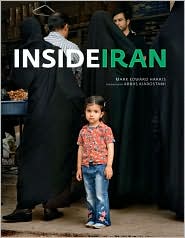
Inside Iran

by Mark Edward Harris
Chronicle Books
  ~ Review in Halifax Herald, September 2009

Iran has been in the news in recent times, perhaps most famously for its links to Iraq and “the axis of evil”.  But when Mark Edward Harris set out to document the daily life of Iranians with his camera, he found a country teeming with people going about their daily business in the manner of people everywhere.  In his most recent book of photography, Inside Iran, Harris wanders the countryside capturing Iran’s geographical diversity and it’s mix of cultures, ancient and modern. 

The resulting photographs are astounding, and continue to remind us that the selected images we see on TV and in newspapers do not reflect the daily life of Iranians.  Harris’s images show a country going about it’s business. A grandfather beams proudly as he holds up his infant granddaughter for the camera. A baker produces walnut cookies, children in jeans and t-shirts smile shyly, and a mullah shows off his shiny motorbike. A suited man is caught in a private ballet as he balances on a window ledge to spray a wasp nest, a portrait of elegance. Children play on a dinosaur at the Natural History Museum of Isfahan, and a shopkeeper smiles a wreath of wrinkles, surrounded by jars and bottles of oil and olives, stacked high in meticulous perfection.

Inside Iran shows the modern and ancient worlds co-existing. Families gather at a teahouse in Shiraz at the tomb of Hafex, a fourteenth century poet who “is considered the undisputed master of the ghazal, a lyrical poem with a single rhyme.” Familiar patterns repeat over and over, in carpets for which Persia is so famous, and in the intricate and ancient inlay work of mosques and buildings.

Harris photographs the women of Iran kayaking, walking hand in hand with boyfriends and husbands, and shooting pool. They are restaurateurs, students, contractors and teachers, and Harris captures their essence.  He particularly excels at portraits and the eyes of his subjects glow from the page, deep and warm.  Inside Iran shows the other side of television, an Iran filled with people whose lives look different culturally and geographically, but underneath it would seem that the hopes and dreams are remarkably similar to our own.

Mark Edward Harris is an award winning travel photographer and documentary film maker who was named Photographer of the Year in 2004 for his work “Mark Edward Harris: Wanderlust" (R.A.M. Publications).

Love’s Civil War

Love's Civil War: Elizabeth Bowen and Charles Ritchie: Letters and Diaries 1941-1973edited by Victoria Glendinning
McLelland and Stewart
  ~ Review in Halifax Herald, September 2009

In wartime London, Charles Ritchie, a Canadian diplomat and Elizabeth Bowen, a successful author, meet at a christening. Their attraction is immediate and they begin an intense and passionate love affair.  Elizabeth is married, and while fond of her husband, she is unable to resist Ritchie.  For 30 years, they meet when they can, never spending more than a week in each other’s company and always reaching forward to the next liaison.

Charles’s position in the diplomatic corps takes him to live in Paris, New York, Ottawa and Bonn. Elizabeth’s letters follow him, letters of hope and love. She was a writer of her times and her letters are rich with descriptions of her days and of friends such as Iris Murdoch, Eudora Welty, Nancy Mitford and Virginia Woolf. But always her words speak of love and of her yearning for their next liaison.

Charles marries his cousin in hopes of companionship, and in one of life’s twists of fate, Elizabeth’s husband dies.  Guilt now complicates Ritchie’s life. “All we have to do now is to live our lives without too great discredit,” he writes.  Elizabeth asks “where am I to send telegrams to now?”

Love’s Civil War is a document of letters and diaries. Unfortunately, while Ritchie kept all Elizabeth’s letters, he destroyed his letters to her after her death in 1973.  His diaries are the only surviving record of his complicated life and they are less satisfying than Elizabeth’s letters, which are vibrant with a joy of life and everyday pleasures.  Ritchie’s diaries are short, and the sometimes terse entries are missing the flavour of reciprocity of feelings that must have been part of his emotional life. His final entry, however, speaks from the heart. “If she ever thought that she loved me more than I did her, she is revenged.”

Victoria Glendinning is an award winning biographer, broadcaster and novelist.  She lives in the UK.