Showing posts with label USA. Show all posts

15 Nov 2023

A Crack in the Edge of the World: America and the Great California Earthquake of 1906 by Simon Winchester

Very clever, Mr Winchester. Under the guise of an entertaining book, you have taught us stuff.  A Crack in the Edge of the World is a course in Geology 101 that is informative and unforgettable in its gravity. Wrapped into these geology lessons are classes in world history and you have tied it all into a rolling travelogue of seismic hotspots on the American continent covering more than 8,000 miles. Page by page you have pulled your readers into the world of earthquakes and tectonic plate volatility, packaged around the tragedy of the San Francisco earthquake and its aftermath. Genius!

The Ring of Fire on which San Francisco is located and, as Winchester gently points out, probably should not be, is aptly named and his tone is measured as he discusses molten centres, tsunamis and the cataclysmic effects of tectonic plates crashing and grinding. He is factual and clear, adopting just the right tone to assuage the alarm we might feel had his language been more inflammatory. Because, in all of this, he has not supplied us with an answer to the big question. ‘What is to be done?’

While admittedly his topic is spectacularly enormous, and the depth and breadth of his research staggering in its scope, Winchester's use of staggering/staggeringly and spectacular/spectacularly to qualify descriptors is something his editor really should not have let slide. But he is forgiven. His ability to communicate and explain complex scientific concepts while holding the attention of his non-scientific readers makes him a master of the creative non-fiction genre, quite enough to convince me to overlook his occasional lapses into hyperbole. Winchester researches his books thoroughly and travels the world in this pursuit. Along the way, he becomes an expert in his field of the day, although, in the case of A Crack in the Edge of the World, it cannot hurt that his undergraduate degree was in geology. The book pivots around the San Francisco Earthquake of 1906, and Winchester takes the time to place this singular event within a geological, historical, and human context and, in doing so, he enchants, informs, and horrifies in varying degrees. An example of enchanting: in 132 A.D. during the Han dynasty, a Chinese astronomer and mathematician, Chang Heng, invented the world’s first seismograph, the hou feng di dong yi, aka the earthquake weathercock. Winchester’s description made me want one. Brass and jade. Dragons and toads. I want to spend time with one, sitting outside my room on a balcony in, oddly, Venice, contemplating the jade frogs and the brass dragons and the da’Vinci’esq’ness of it all.

After finishing his research in San Francisco, Winchester sets out in a jeep on what has to be the longest detour in the world. He leaves San Francisco for the east coast via the Alaska Highway, adding 4,000 miles to his journey. He drives to Milepost 1,314, where he “turns left for Anchorage.” He is looking for the Alaska oil pipeline and he finds it wandering unprotected through the pristine wilderness, built “high off the ground to allow migrating caribou to pass beneath it.” 800 miles of Mitsubishi-made steel tube on Teflon-coated sliders. He thinks of explosives and how easy it would be! But what really interests Winchester is the care the builders have taken in their design which allows the pipeline to flex when needing to deal with seismic activity. Because it sits on the Denali Fault, which is an intrinsic part of that aforementioned Pacific Ring of Fire.

Another Winchester detour. Another 4,000 miles, this time to Yellowstone National Park in Wyoming which, he writes, “is ready for an eruption almost any day.” There have been indications but all that is known is that “when it happens, it will almost certainly be vast. It is that 'almost certainly' that gives us permission to continue to ignore the inevitability of what Winchester is saying. If we don't talk about it, it may not be true. It's not totally certain, after all, only almost. Lynn Truss (author of Eats, Shoots and Leaves: The Zero Tolerance Approach to Punctuation) has a simple rule about qualifying absolutes. Don't! However, considering Winchester's superior command of English, I think he was being deliberate. This is 'benefit of the doubt' stuff. He is giving us permission to suspend our belief to that little bit of the story. I'm in and I'm sure Truss probably would be too.

STIFF: The Curious Lives of Human Cadavers by Mary Roach

  STIFF (Norton, 2003) by Mary Roach is a minefield! Whether discussing grave robbing (entertaining), the brutality of crash tests cadavers (informative), puppy mutilations (horrifying), or human head transplants (macabre and horrifying), Roach shirks from nothing and conceals not a detail. Not - A - Detail! She does, however, remain cognizant that her readers occasionally need air, and she always intercedes at that pivotal moment as we dazedly stumble toward the minefield. Take a moment, my readers, she allows. Breath. We do, and she moves on.  

    About twenty-five years ago, after watching yet another documentary on battery chicken farms, I became a vegetarian, although I continue to eat and love seafood. Very unfortunately, but quite correctly, Roach compares deep frying live newborn mice (a Chinese delicacy) with tossing live lobsters into boiling water (a Nova Scotia delicacy). This audiobook paragraph was inexorable and, try as I might, I cannot unhear it. As I cross lobster off my diminishing list of protein sources, I curse you, Mary Roach!

     Roach’s book is instructive and gives us clarity about the modern lives of cadavers and the sometimes wonderful, sometimes horrifying history of how we got here. Donating one’s body to science is consenting to scientific research and everything that entails, she says, and that is something we usually don’t think about. Donating is different from being an organ donor. It is a complete abandonment of the body and it gives blanket permission for all that follows. Medical students learn and surgeons practice their skills. Crash testing real bodies do the job a synthesized body cannot. It is brutal but essential research in vehicular safety. A side benefit is that I have learned enough to become a grave robber using only tools from my hall closet. I suspect, however, that this market has already bottomed out.

          Roach delves deeply into the history of cadavers, travelling the world to gather research and to gain insight into cultural traditions and processes. My personal favourite is the ‘Mellified Man’ recipe which Roach includes under medicinal cannibalism in Chapter 10: Eat Me. The mellification process goes like this. An elderly person volunteers to eat and bathe in honey until dead, which apparently takes about a month. The body is placed in a stone coffin, covered in honey, and steeped for one hundred years, after which time a confection has formed. This confection is administered topically or orally for the treatment of broken and wounded limbs and other ailments. “A small amount taken internally will immediately cure the complaint.” Roach writes that Li Shih-chen, author of the Chinese Materia Medicat (1597) expressed doubts about the veracity of this story. He did, however, include the recipe in his book. STIFF is informative, entertaining, and historically fascinating, and occasionally deeply disturbing. However, Roach is never distasteful in the details, distressing though they sometimes are. She writes without emotion and without judgment, and her wry humour carries us from one difficult topic to another, acting as a parachute lest we spin into freefall.

         “Because dead people look very much like live people,” Roach says in an interview with Tyler Cowen at George Mason University, “there is a tendency to treat them as though they are still people.” But she reminds us that cadavers are not people and, “as cadavers, they have superpowers that give us answers we can’t get any other way.”(https://www.youtube.com/watch?v=kjwgML2Sm9w&feature=emb_title). 

       Roach is driven by curiosity. Watching the interview with her is like seeing sparks dance above a campfire. She is witty, chatty, and immensely knowledgeable about her research. I read, listened, watched, and learned. Her ready smile, engaging chatter and merry laugh are quite at odds with her authorial topics. Defecation Induced Sudden Death? A real thing. It killed Elvis. At what point should roadkill not grace the dinner table? Undecided.

          There are few authors who would write, or could write, a book such as STIFF and it seems to me that Mary Roach has written the unwritable. STIFF is a splendid marriage of history, scientific evolution, horror, fact, and humour and it carefully informs those among us who wish to donate our bodies to science. Roach’s books are widely read and continue to make the New York Times bestseller list. STIFF The Curious Lives of Human Cadavers is not, however, a book for the fainthearted.  

26 Nov 2022

Men Explain Things to Me by Rebecca Solnit


Rebecca Solnit’s website describes her as a writer, a historian, and an activist. She has published more than twenty books on topics as diverse as Western and Indigenous history, feminism, insurrection, social change, and popular power. She has won several awards, including the Kirkus Prize for Nonfiction in 2018. Solnit was catapulted into the spotlight with the publication of her essay, “Men Explain Things to Me”, which is also the title of a small volume of essays covering topics such as mansplaining, violence against women, global injustice and marriage equality, or same sex marriage. 

Use the word “mansplaining” in a conversation and you will get a chuckle, an outright laugh, or an expression of annoyance, reactions usually dependent on gender. The word says it all and it was the NYTimes word of the year in 2010. Solnit is sometimes credited with being the first to use it although she denies this.

Men Explain Things to Me is a book of opinion essays which opens with a piece on 'mansplaining'. Solnit is careful not to include all men in the ‘explaining’ category, perhaps a little too careful. Wishing not to offend those men who ‘get it’ negates the overarching point. Solnit lays out the idea that ‘mansplaining’ is offensive and, not only does it drive women crazy, it also effectively silences us. To imply “but don’t worry, most of you don’t do this,” is a fatal flaw and blurs the point. Men, all men, need to look at and examine how they interact with women in serious conversation. Those who ‘get it’ can then be part of the solution.

In an article published in The Walrus, Viviane Fairbank credits Solnit with saying that “Writing is primarily about gathering.” What Solnit does not tell her readers in her book are the sources of her gathering. Her articles are not researched pieces of creative non-fiction. They are opinion pieces which include the word “I” just a little too often and uses dramatic literary devices to make her sometimes suspect points. In “Worlds Collide in a Luxury Suite”, the essay begins: “How can I tell a story we already know too well. Her name was Africa. His was France.” Dramatic indeed, but without a context, an uninformed reader may now believe that France colonized Africa! Solnit must know that Africa is not a country and that France did not go in alone!

Solnit’s essays are about women being silenced and the myriad of ways men behave (consciously or unconsciously) that actively contribute to women not being heard. While Solnit’s writing is entertaining, what the book lacks is analytic substance and, because Solnit is a self-declared feminist, it would not be unreasonable to ask for some underpinnings of a feminist analysis. We need something to think about and debate round the dinner table. It is this lack of substance that denigrates women’s struggles, says Fairbank. and it reduces them to common denominators of pop-psychology “without ever explaining what that conversation will actually produce once its over.” This element of pop feminism in Solnit’s writing reduces it to points that she subtly works to negate. As Fairbank says, “this makes feminism more accessible than ever, while simultaneously trivializing the cause.”

Men Explain Things to Me is an entertaining read that is sometimes witty and occasionally laugh-out-loud funny. It is also deadly serious and serves as a reminder to us all that millions of women around the world live in desperate circumstances, without a voice, without resources and without personal or political power. However, the book does not provide us with an accurate context or an analysis of why this is happening and what can be done about it. Without this context, Solnit’s writing lacks purpose. Her readers can gasp in horror, weep in sympathy, and stand united in sisterhood, but that will change nothing. Until we as humans move beyond the reactive to reach a true and fundamental understanding of why things are structured this way, the status quo will not change. Being part of change must be the objective and learning to think critically about the issues Solnit raises in her essays is how we can participate in change. But we won’t be encouraged to do so by this book.

10 Apr 2011

Your Voice in my Head

Your Voice in My Headby Emma Forrest ~ Random House Canada
  ~ Review: Halifax Herald, March 2011

Emma Forrest began writing a column for the (UK) Sunday Times at the precocious age of 16.  At 21, she was writing for The Guardian.  She published her first novel at 22, moved to New York and fell in love with a movie star she calls GH, her Gypsy Husband.  The world was at her feet.

But the reality of Forrest’s life was far from idyllic. She was sinking deep into mental illness and one day she realized that “her quirks had gone beyond eccentricity, past the warm waters of weird to those cold, deep patches of sea where people lose their lives.”  Bulimia and cutting were her way to feel, to bring her back to the present and she slid into a spiral of destruction and self hate that almost claimed her life.

Forrest was lucky.  She found Dr. R, a psychiatrist of enormous compassion and wisdom, “a man who though I never saw him outside one small room, believed that life is vast and worth living.”  He is the voice in her head, her connection to sanity.

As Forrest fights to gain solid ground, her perspective begins to shift.  The men who had loved and left her – GH, Dr. R. “... were good and kind to me, they loved me and I loved them back and the shock at the finish holds no wisdom.”

Forrest’s writing has a flavour of Lara Jefferson’s compelling memoir, These are my Sisters. Jefferson was committed to a mid-west insane asylum in the early 50's and decided that her way back to the world was to write her way sane.  She was successful.

Forrest’s memoir is equally compelling.  In spite of the craziness of the places she fights to rise above, her writing is witty and cool.  Actually, Forrest is cool, and even in her darkest days she manages to keep an engaging humour in her prose as she writes her way back from the edge.

Emma Forrest has been writing since she was a child.  She is a columnist, the author of four books and a successful screenwriter. She lives in LA.

2 Mar 2011

Mandela’s Way: Fifteen Lessons on Life, Love, and Courage

by Richard Stengel
Crown Publishers
  ~ Review in Halifax Herald, August 2010

When Richard Stengel collaborated on Nelson Mandela’s autobiography, The Long Walk to Freedom, he spent three years traveling with Nelson Mandela, gathering and distilling information from countless hours of interviews and conversations.  He was present at some astonishing moments as the new South Africa began to shake off the years of apartheid.  But in his new book, Mandela’s Way, Stengel gives us Nelson Mandela himself, the man who has appeared to the world as larger than life.

These fifteen lessons are Mandela’s wisdom, the thinking and philosophies of an extraordinary man who, when faced with tremendous hardship, refused to let his humanity and spirit be co-opted.  He was a strategic man, a gardener, someone who thought carefully before deciding on a course of action. “Most of the mistakes he made in his life came from acting too hastily rather than too slowly. Don’t hurry, he would say; think, analyze, then act.”

At his trial where Mandela faced a possible death penalty, he ended his testimony by saying “. . . I have cherished the idea of a democratic and free society in which all persons live together in harmony and with equal opportunity. It is an ideal which I hope to live for and to achieve. But if needs be, it is an ideal for which I am prepared to die.”

The back cover of this book categorizes Mandela’s Way as a “Self Help - Personal Growth” book - a puzzling and somewhat glib label to apply to a book which outlines the personal philosophy of a great statesman, a man who calls the world’s inhabitants family. Mandela’s Way is part history, part philosophy, part storytelling and always inspiring. Nelson Mandela has much to teach us and some of us have much to learn. However, Mandela’s Way doesn’t preach, or advocate that we change to suit a model. That is not his way.  This book simply tells us of how an ordinary man became extraordinary, a lover of people and of life, and it does so in simple direct language which contains the lessons if we want them.

In Richard Stengel’s words: “Many times, I had to ask myself ‘What would Nelson Mandela do?’  …  It always made me, at least in those moments, a better person - calmer, more rational, more generous.”

Richard Stengel is the editor of Time magazine, author and documentary film maker. He collaborated with Nelson Mandela on Mandela’s autobiography, Long Walk to Freedom.

Secret Daughter

by Shilpi Somaya Gowda
William Morrow
  ~ Review: Halifax Herald, July 2010

Kavita lives in a small, impoverished village in rural India. Tradition dictates that she must bear her husband a boy. But when a girl is born, her husband takes the child and leaves the house. He returns without her. Her second child is also a girl, but this time Kavita fights back. She gives the  baby a name - Usha - and within hours of the birth, she and her sister walk the long journey to Bombay. There she leaves the child at an orphanage with a silver bangle, a name and a chance at life. Those are her gifts.

Somer and Krishnan are successful physicians in California. Unable to have children, they decide to adopt. They travel to Krishnan’s native country and at an orphanage in Bombay, they are enchanted by the baby with the unusual eyes, whose name has been muddled to Asha. They return to California and settle down to live the American dream. India is far away, geographically, culturally and emotionally. Or so it seems.

Secret Daughter is a family saga and Gowda moves back and forth between continents and cultures effortlessly. This is a story of the endurance of hearts, of marriages, of women, and of our heart’s need to find the place we belong. Gowdas descriptive prose creates rich visuals of the crowded streets and steaming heat of Bombay. She contrasts this with the sterility of the nuclear family life of Krishnan and Somer. When Asha goes to Bombay with a journalist project to work with children of the slums, she is embraced by her sprawling extended family who are grateful and delighted to finally welcome this Indian/American child.

Kavita never stops yearning and hoping for her daughter. Gowda gives a face to the anguish of women who give birth to unwanted girl children who are taken away, perhaps even killed, but they are never forgotten by the mothers who bear them. These women carry grief through their lives for the daughters they were unable to protect.

Gowda tells a rich, interconnected story of families and of ties that never break, no matter how thinly they are stretched or how far the distance of time or geography.

Shilpi Gowda is a native of Canada, growing up in Toronto before moving to the USA. She currently lives in Texas with her husband and children. This is her first novel.


This Time Together

From the Trade Paperback editionby Carol Burnett
Harmony Books
  ~ Review in Halifax Herald, June 2010

Its been a surprising thirty-two years since Carol Burnett tugged her ear for the last time, ending the enormously successful show that endeared her to millions.  Ms Burnetts new book, This Time Together Laughter and Reflection tells us what her audiences already knew.  Making that show was the best time ever! For the cast and crew, rehearsals and shooting days were full of belly laughs and friendship. Were just going to go out there, and get in the sandbox, and were going to play and have fun, writes Ms Burnett.  They did just that.

Her big break came when she was cast as Princess Winifred the Woebegone in Once Upon A Mattress. The Broadway show was supposed to run six weeks and ran for fifty-two.  Then came The Carol Burnett Show and the rest, as they say, is history.

            This Time Together is a series of autobiographical sketches where people such as Cary Grant, Lucille Ball, Julie Andrews and Peggy Lee wander through the pages.  Ms Burnett is generous with her praise for the talents of those who worked with her through her career, the writers, producers, directors and a supporting cast of thousands.  The anecdotes do not often stray into her personal life, although she does share her devastation at the loss of her beloved daughter, Carrie, to cancer.

Her co-stars on The Carol Burnett Show, the late Harvey Korman, Tim Conway and Vicki Lawrence, feature prominently in her book.  She talks about the fun, the laughter and the tears.  “Unfortunately, our show has been accused of showing actors cracking up at times, breaking character. . . I dare anyone to be on camera and keep it together when Conway gets on a roll.”  Surely this was the best part! Utube is littered with sketches from the show - the legendary Dentist skit, the award winning Went With the Wind, Stinky, theyre all there, as funny as ever.

Ms Burnett closes her book with thanks and her list of Gratefuls for what life continues to offer. Her family, her children and grandchildren, her career, her health.  We are left smiling, reminded of the laughter she brought into our lives.  For this, we too are grateful.

Carol Burnett has been an actor on Broadway, television and in the movies. She starred in the long running The Carol Burnett Show, which won twenty-five Emmy Awards.  This is her second book.

The Art of Choosing

by Sheena Iyengar
Twelve, Hatchett Book Group
  ~ Review in Halifax Herald, May 2010

As humans we want choices.  We like to weigh the odds and ponder.  Sometimes we act impulsively, making choices without thinking, even when those choices have far reaching consequences.  Sheena Iyenga, in her new book, The Art of Choosing, says it is the act of choosing we love, perhaps more than the result.  Indeed, after the choice is made, self-doubt can set in, causing us to question our decision.

Iyengar has researched choice for many years.  She catapulted to research stardom with her now famous jam experiment, in which a taste test showed that people were much more likely to buy the product if the number of choices were less rather than more.

Through choice, we construct our lives, she says. We like to think of ourselves as unique - but to not too unique.  Not really.  “What we want is something a little less extreme that true uniqueness. . . we want to stand out from the majority, but usually not in a way that makes us part of a glaring and lonely minority.”

She is clear - advertising creates trends, dictates fashion and convinces us that certain products are sexy’ or ‘trendy. Bottled water is a classic example.  It is often the same water we can get by turning on the kitchen faucet, yet it sells in large quantities.  Why is this? she asks. And can we change how we choose?

The Art of Choosing is thoughtful and thought-provoking.  Iyengar presents her research and conclusions in clear, accessible prose which is entertaining, fascinating and more than a little frightening as she posits just how much real choice we have. 

Understanding ones choices is a creative process, she says.  And “insisting on more when one already has a great deal is usually a sign of greed.  In the case of choice, it is also a sign of the failure of the imagination, which we must avoid or overcome if we wish to solve our multiple choice problem.”

Sheena Iyengar is a professor of business at Columbia University.  She has studied choice for many years and is a leading expert on the subject.  This is her first book.

Day out of Days

From the Trade Paperback edition by Sam Shepard
Knopf Canada
  ~ Review in Halifax Herald, April 2010

On the surface, Sam Shepards latest collection of short stories is a road trip.  But just on the surface. Dig a little deeper. These stories dont follow any traditional route.  They wander from town to town, and are sometimes surreal, sometimes touching, often macabre.  Some are very short, some not so much.  There are random fragments, rants, the occasional monologue, some poetry, and stories from the past.  Stories from the heart.  They yearn and plead.  But always they are searching, wanting, looking for perspective as age gathers in, for a reason for it all.  Looking for peace.

Occasionally, there is a story that is downright creepy, although strangely, not the one about the severed head lying in a ditch begging a passerby to take him to a lake (Haskell, Arkansas: Highway 70). Far from it. When the man refuses and passes by, “the head calls out to him in the most forlorn and melancholy voice the man has ever heard.”  The man returns.  “Do you think you could open your eyes for me? Just once?” asks the man.  “No”, says the head, without hesitation.  “... you wouldnt be able to take it.”  They strike a deal, the man and the head, and they set out together through several stories.

Shepards writing is compelling.  With the artistry of a craftsman, he drags his readers in and holds them, page after page. Staccato sentences mark his aggressive, hard-edged style.  Land of the Living is a marriage in limbo, partners lost from each other, familiarity and children holding the threads together on the family vacation. “We behaved decently ... remembering the days we were seldom out of each others sight and had no reason to doubt we would be forever in love.”

Shepard takes us to the Krispy Glaze donut shop of his youth, to Las Vegas, to Knoxville, Tennessee, through a whiteout in Wichita, Kansas where traffic is stopped dead. “Thank God for Guy Clark on my satellite radio.”  But in Gracias, the small, touching finale, Shepard gives his final gift and lets his readers close the book with a soft smile. Perfect!

Sam Shepard is a Pulitzer Prize-winning playwright, author and actor. His books have won many awards, and he has acted in more that thirty movies, receiving an Oscar nomination for The Right Stuff.  He lives in New York and Kentucky.

Hannah’s Dream

Hannah's dream: a novel [Book]by Diane Hammond
HarperCollins
  ~ Review in Halifax Herald, February 2009

In a small private zoo on the grounds of Havenside near Puget Sound, lives an elephant. Hannah is small, blinded in one eye as a baby and rescued from Burma by Max Biedleman. Max was a visionary, a woman whose dignity, compassion and foresight holds the zoo together long after her death. Before she dies, she appoints Hannah’s keeper, Samson Brown, to be the elephant’s legal guardian. And Sam loves ‘exactly two things in his life: his wife and his elephant.’ For 41 years, Sam and Hannah spend their days together, walking, watching TV and growing old. The problem is that Sam is growing old faster than Hannah.

Hammond has created some quirky and endearing characters in Hannah’s Dream. There is Truman, single parent and zoo accountant, who buys a Vietnamese pot-bellied pig as company for his son, with interesting results.  Neva Wilson, a young elephant keeper hired to replace Sam when he retires, teaches Hannah how to paint. Corinne, Sam’s wife, spends many evenings watching movies in the elephant enclosure and believes Hannah to be the reincarnation of her dead baby girl. And Harriet Saul, the Zoo’s Director,  is just a nasty piece of work.  Together, this unlikely group staggers toward understanding what needs to happen to ensure Hannah’s healthy and happy future.

Hammond has created a love story with Hannah at the centre, who loves unreservedly and who is loved passionately in return. Hannah’s Dream is a heartwarming story with an intelligent, quiet message that is hard to ignore.

This is Diane Hammond’s third novel. She worked in public relations for many years, and was the media spokesperson for Keiko, the killer whale who starred in Free Willy. She lives in Oregon.

Last Night at the Lobster

Last Night at the Lobsterby Stewart O’Nan
Penguin
  ~ Review in Halifax Herald, March 2009

“Midmorning and the street lights are still on, weakly.” Manny DeLeon drives to work through mall traffic on a gray winter day. He is 35, and manages the Red Lobster, a strip mall restaurant, which is about to close for good. Manny and five of his 44 staff will transfer to the Olive Garden.  Christmas is in four days.

O’Nan’s easy writing breathes life into Manny and his staff. He does it slowly, skillfully, until we are rooting for them, but for Manny most of all. He guides the story forward, a hardworking, loyal guy stumbling through life, sentimental, without introspection. He takes life as it comes.

Last Night at the Lobster chronicles Manny’s last day as he rallies his staff and opens the doors for the last time.  They move through well established routines. He hopes Jacqui will come. He really wants that. He salts the parking lot, buys a Christmas present for his pregnant girl friend.  The kitchen staff turn up and serve lunch to ‘escapees from the mall’. The storm worsens, tempers fray and one by one his staff takes a hike into the snow.

O’Nan has been called ‘the bard of the working class.’  He writes of hard working, ordinary people who take pride in their work, not because they have to but because it’s in them.  Last Night at the Lobster begins slowly, following Manny through his easy working day rhythm to the end. He locks the money in the safe, closes the door for the last time, and trudges into the snow.  Tomorrow at the Olive Garden.

Stewart O’Nan was named by Granta as one of America’s Best Young Novelists.  He is the author of several books and lives in Connecticut.

The Myth of Multitasking: How “Doing It All” Gets Nothing Done

by Dave Crenshaw
Wiley
  ~ Review in Halifax Herald, March 2009

Helen is the Queen of multitasking.  She expects her employees to be good multitaskers.  She works hard, juggling emails, phone calls, interruptions and meetings, and yet, at the end of the day, feels like an underachiever.  But Helen is a senior executive in a large retail clothing chain.  She didn’t get there by underachieving.  Her workday feels out of control and her time slips away, used up by ‘active’ and ‘passive’ interruptions.  Helen hires a consultant to help her get a handle on things.

Dave Crenshaw has touched a nerve with his new book.  He posits that multitasking is a myth, that in spite of our belief that multitasking makes us more productive, the reverse is actually true. The human brain, he says, is not capable of doing more than one activity at a time. What we are really doing, when we think we are multitasking, is ‘switchtasking’, switching rapidly back and forth between tasks, a process that results in lost time, lost productivity and frustrated workers. “The brain is a lot like a computer. You may have several screens open ... but you’re able to think about only one at a time.” Switchtasking, says Crenshaw, is neither effective nor efficient. It is, at best, counterproductive.

The Myth of Multitasking is an easy read.  Crenshaw has written it as a dialogue between Helen and Phil, the consultant she hires.  While this dialogue is sometimes stilted and simplistic, the device allows Crenshaw to make his point clearly and effectively.  Unless we assume control over our technological workday, he says, and learn to manage interruptions effectively, we will “be run over by the traffic of information ... The reality is that these things will make us productive only if we learn to take control of them.  They are the servants, we are the masters.”

Dave Crenshaw is a management expert who coaches and trains CEO’s and management teams worldwide.

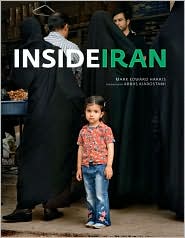
Inside Iran

by Mark Edward Harris
Chronicle Books
  ~ Review in Halifax Herald, September 2009

Iran has been in the news in recent times, perhaps most famously for its links to Iraq and “the axis of evil”.  But when Mark Edward Harris set out to document the daily life of Iranians with his camera, he found a country teeming with people going about their daily business in the manner of people everywhere.  In his most recent book of photography, Inside Iran, Harris wanders the countryside capturing Iran’s geographical diversity and it’s mix of cultures, ancient and modern. 

The resulting photographs are astounding, and continue to remind us that the selected images we see on TV and in newspapers do not reflect the daily life of Iranians.  Harris’s images show a country going about it’s business. A grandfather beams proudly as he holds up his infant granddaughter for the camera. A baker produces walnut cookies, children in jeans and t-shirts smile shyly, and a mullah shows off his shiny motorbike. A suited man is caught in a private ballet as he balances on a window ledge to spray a wasp nest, a portrait of elegance. Children play on a dinosaur at the Natural History Museum of Isfahan, and a shopkeeper smiles a wreath of wrinkles, surrounded by jars and bottles of oil and olives, stacked high in meticulous perfection.

Inside Iran shows the modern and ancient worlds co-existing. Families gather at a teahouse in Shiraz at the tomb of Hafex, a fourteenth century poet who “is considered the undisputed master of the ghazal, a lyrical poem with a single rhyme.” Familiar patterns repeat over and over, in carpets for which Persia is so famous, and in the intricate and ancient inlay work of mosques and buildings.

Harris photographs the women of Iran kayaking, walking hand in hand with boyfriends and husbands, and shooting pool. They are restaurateurs, students, contractors and teachers, and Harris captures their essence.  He particularly excels at portraits and the eyes of his subjects glow from the page, deep and warm.  Inside Iran shows the other side of television, an Iran filled with people whose lives look different culturally and geographically, but underneath it would seem that the hopes and dreams are remarkably similar to our own.

Mark Edward Harris is an award winning travel photographer and documentary film maker who was named Photographer of the Year in 2004 for his work “Mark Edward Harris: Wanderlust" (R.A.M. Publications).

Reasons for and Advantages of Breathing

by Lydia Peelle
Harper Perennial
  ~ Review in Halifax Herald, September 2009

The introduction of tractors revolutionized farming methods.  Life got easier and production increased. Mules were no longer needed to haul great loads of firewood, move boulders or plow the fields. The opening story of Lydia Peelle’s first book of fiction, Mule Killers, tells of the year the mules were trucked away, “sleek and fat on oats, work-shod and in their prime.”  The year of the International Harvester marked the end of Orphan Lad, Willy Boy, Champ, Kate and Sue.

Sweethearts of the Rodeo is a coming of age story. The narrator and her friend spend the summer working with horses, taking chances and living wild. “Our bodies forgive us our risks,” she says, “and the ponies do, too.  We have perfected the art of falling.”

“I meet the herpetologist on the bus” begins the title story, and an unlikely friendship develops between an elderly herpetologist and a young woman at a turning point in her life.  It is an enchanting and prophetic tale of discovery. In the rooms behind the herpetologist’s office, heated aquariums provide homes for anoles, salamanders and gila monsters.  “All these diverse adaptations, with one common goal,” says the herpetologist. “To live to see tomorrow.”

In her first collection, Peelle shows herself a master of succinctness, those few well chosen words which convey a wealth of meaning.  The prose in Reasons for and Advantages of Breathing is poetic and the stories are diverse and unusual, each one leaving a lingering, pleasurable aftertaste. But eight stories are not enough - we must hope for more.

Lydia Peelle’s short stories have won several awards, including the O. Henry Award.  Reasons for and Advantages of Breathing is her first book.  She lives in Nashville, Tennessee.

Still Alice

 by Lisa Genova
Simon & Schuster
  ~ Review in Halifax Herald, September 2009

Getting a book published is not easy.  It can be downright discouraging for authors to get their work into print.  And so it was for Lisa Genova.  After finishing Still Alice, she realized it could take years to find a publisher.  But she believed in her story and so did the National Alzheimer’s Association, so initially Genova published it herself.  The rest, as they say, is history.

Alice Howland is an educated, energetic woman at the peak of her career as a professor of psychology at Harvard University.  Her children are grown and on the road to their chosen careers.  Grandchildren are on the way, her marriage is solid and life is good - until she begins to forget things.  She gets lost on her regular running route.  She sits waiting with her students for the lecture to begin, the one she should be teaching.  Finally, her anxiety sends her to a specialist who gives her the devastating diagnosis - early onset Alzheimer’s.  She is 50 years old.

Still Alice is written from inside Alice’s mind.  She is aware of her deterioration and “pictured her Alzheimer’s as a demon in her head, tearing a reckless and illogical path of destruction …”  

Genova’s background in neuroscience gives authority to her writing.  She weaves a wealth of information into her story with clarity and simplicity.  Remarkably, she never loses sight of the fact that Still Alice is a novel, something which entertains by its very nature.  She keeps the fine balance, drawing her readers in.  We root and cheer for Alice.

As her identity slips away, Alice fights back but she understands the inevitable outcome. “She thought about the books she’d always wanted to read … the ones she figured she’d have time for later.”  Time is not on Alice’s side.

Alice’s family struggle to accept her diagnosis.  They are conflicted, each one of them viewing the illness and the future through very different lenses.  But as their understanding of Alzheimer’s progresses, they finally begin to make the adaptations and compromises necessary to keep Alice in their lives.

To Genova’s credit, this is not a depressing story of a life spiraling into despair and blankness.
Still Alice is about ever changing identity, and the willingness of families to adapt and change for those they love.

Lisa Genova holds a Ph.D. in neuroscience and is an online columnist for the National Alzheimer’s Association.  This is her first novel.

1 Mar 2011

Hannah’s Dream

Hannah's Dream, Little Brown Book Group, UKby Diane Hammond
HarperCollins
  ~ Review in Halifax Herald, February 2009

In a small private zoo on the grounds of Havenside near Puget Sound, lives an elephant. Hannah is small, blinded in one eye as a baby and rescued from Burma by Max Biedleman. Max was a visionary, a woman whose dignity, compassion and foresight holds the zoo together long after her death. Before she dies, she appoints Hannah’s keeper, Samson Brown, to be the elephant’s legal guardian. And Sam loves ‘exactly two things in his life: his wife and his elephant.’ For 41 years, Sam and Hannah spend their days together, walking, watching TV and growing old. The problem is that Sam is growing old faster than Hannah.

Hammond has created some quirky and endearing characters in Hannah’s Dream. There is Truman, single parent and zoo accountant, who buys a Vietnamese pot-bellied pig as company for his son, with interesting results.  Neva Wilson, a young elephant keeper hired to replace Sam when he retires, teaches Hannah how to paint. Corinne, Sam’s wife, spends many evenings watching movies in the elephant enclosure and believes Hannah to be the reincarnation of her dead baby girl. And Harriet Saul, the Zoo’s Director,  is just a nasty piece of work.  Together, this unlikely group staggers toward understanding what needs to happen to ensure Hannah’s healthy and happy future.

Hammond has created a love story with Hannah at the centre, who loves unreservedly and who is loved passionately in return. Hannah’s Dream is a heartwarming story with an intelligent, quiet message that is hard to ignore.

This is Diane Hammond’s third novel. She worked in public relations for many years, and was the media spokesperson for Keiko, the killer whale who starred in Free Willy. She lives in Oregon.