10 Apr 2011

Your Voice in my Head

Your Voice in My Headby Emma Forrest ~ Random House Canada
  ~ Review: Halifax Herald, March 2011

Emma Forrest began writing a column for the (UK) Sunday Times at the precocious age of 16.  At 21, she was writing for The Guardian.  She published her first novel at 22, moved to New York and fell in love with a movie star she calls GH, her Gypsy Husband.  The world was at her feet.

But the reality of Forrest’s life was far from idyllic. She was sinking deep into mental illness and one day she realized that “her quirks had gone beyond eccentricity, past the warm waters of weird to those cold, deep patches of sea where people lose their lives.”  Bulimia and cutting were her way to feel, to bring her back to the present and she slid into a spiral of destruction and self hate that almost claimed her life.

Forrest was lucky.  She found Dr. R, a psychiatrist of enormous compassion and wisdom, “a man who though I never saw him outside one small room, believed that life is vast and worth living.”  He is the voice in her head, her connection to sanity.

As Forrest fights to gain solid ground, her perspective begins to shift.  The men who had loved and left her – GH, Dr. R. “... were good and kind to me, they loved me and I loved them back and the shock at the finish holds no wisdom.”

Forrest’s writing has a flavour of Lara Jefferson’s compelling memoir, These are my Sisters. Jefferson was committed to a mid-west insane asylum in the early 50's and decided that her way back to the world was to write her way sane.  She was successful.

Forrest’s memoir is equally compelling.  In spite of the craziness of the places she fights to rise above, her writing is witty and cool.  Actually, Forrest is cool, and even in her darkest days she manages to keep an engaging humour in her prose as she writes her way back from the edge.

Emma Forrest has been writing since she was a child.  She is a columnist, the author of four books and a successful screenwriter. She lives in LA.

They Fight Like Soldiers, They Die Like Children

by Roméo Dallaire ~ Random House Canada
  ~ Review: Halifax Herald, March 2011

It is becoming common to read about ‘child soldiers’ forced to fight in the ranks of warring factions in distant countries. These children are used by armies as weapons of war, often sent in as the first wave in combat.  They are expendable and they commit atrocities beyond imagining.

There are many reasons armies use children as weapons. “Children … are easy and cheap to maintain. They eat and drink less, they are not paid, they do not have to be particularly well clothed, sheltered, armed or logistically sustained ... There are no rights for child soldier, only privileges.”

In his new book, They Fight Like Soldiers, They Die Like Children, Roméo Dallaire exposes the terrible circumstances of child soldiers. These children are taken from their families, brainwashed with drugs and violence, raped and forced to perform acts of violence beyond comprehension. If they falter, they are beaten or sometimes shot, often by another child.  They have nowhere to turn, and there is none to help.

Children are hard to fight against and rebel armies count on this. Adult soldiers hesitate to shoot or harm a child.  “Not only do children present moral dilemmas for legitimate forces, but they also throw the ‘game of war’ into a tailspin.”

They Fight Like Soldiers, They Die Like Children is a call to action. Dallaire’s writing is dispassionate and calm and yet the urgency of his message is aimed at us all. Protection of children is a responsibility of the world, he says. We must stop this now. We must agree how to take action so not one more child loses what all our children deserve – a childhood.

Roméo Dallaire’s first book, Shake Hands with the Devil, won the Governor General's Award for non-fiction.  He has received numerous honours and awards and has spearheaded the Child Soldiers Initiative, a partnership of organizations working to eliminate the use of child soldiers in armed conflicts.

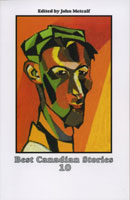
Best Canadian Stories 10

10: Best Canadian Storiesedited by John Metcalf ~ Oberon Press
  ~ Review: Halifax Herald, March 2011

“Mavis Gallant said that the one question to ask of a story, a book, a painting or a building is: ‘Is it alive or dead?’ Check this year’s vital signs,” writes John Metcalf  in the introduction to Best Canadian Stories 10.   Metcalf is right of course. Oberon’s 2010 short story collection speaks for itself.  These stories overflow with life and living and once again, Metcalf shows his ability to find the best.

Hold Me Now (Stephen Gauer) tells the story of a father who is given the shocking news that his son has been murdered.  As he attempts to make sense of it all, his life becomes linked with that of Curtis, his son’s underage killer.  Gauer’s understated tension through the ensuing trial and the events that follow is masterful. Anna (A Small Haunting by Shaena Lambert) begins to think she is quietly going mad when she finds her house is haunted by a small child. And Maude befriends a strange young girl called Kreetch (Daytrip by Patricia Young) who arrives at the library every day after school.   The gentle tenderness of Young’s story is the perfect opening to this year’s collection.

Oberon’s commitment to providing a platform for new and emerging short story writers in Canada is laudable, and this year’s collection stands with the best. Bring on Best Canadian Stories 11!

John Metcalf is a well-known Canadian author and editor.  He immigrated to Montreal from the UK as a young man.  He has been editing this collection for Oberon for many years, in the company of authors such as David Helwig and Joan Harcourt.  He lives in Ottawa.

Granta: Going Back

Granta: Going Back
Edited by John Freeman 
House of Anansi Press
  ~ Review: Halifax Herald, February 2011 

Short stories are often the first thing new writers publish.  They go in and out of popularity, and finding a home for that first story can be difficult.  Since it’s makeover in the 1970's, Granta has played a significant role in providing a market for new writers and artists, publishing short stories, photojournalism, poetry, biographies, indeed anything that is able to loosely fit within its pages.  It is indeed “The Magazine of New Writing”.

Going Back is a ‘themed’ issue based somewhat loosely on “what happens after we go back”. It diverges from Granta’s norm in that the writers and artists are well established. Editor John Freeman has put together a splendid collection of stories, poetry, art and photography about loss, memories, joy and finding the ability to let go. 

Janine di Giovanni’s The Book of the Dead brings into sharp focus the human spirit’s ability of to survive under seemingly impossible conditions of deprivation and loss during the war in Sarajevo.  Ian Teh’s stark photography of industrial China (Traces: China 1999 - 2010) speaks volumes and Missing Out by Leila Aboulela tells the story of the collision of cultural values within a marriage.  Elizabeth McCracken’s Property shows the heart of a young widower as he struggles with his loss.

There is a previously unpublished excerpt from Mark Twain’s diaries, and a series of letters written over 30 years by Iris Murdoch to French writer Raymond Queneau. (It is believed that she destroyed his letters to her.)  It is tricky to find a favourite amidst such talent.

Since its inception in Cambridge, UK, in 1889, Granta has published the works of writers such as A. A. Milne, Doris Lessing, Ian McEwan, Gabriel Garcia Marquez, Arundhati Roy and Sylvia Plath. It was rescued from oblivion in the 1970s, and the rest, as they say, is history.

The Beauty of Humanity Movement

The Beauty of Humanity Movement
by Camilla Gibb
Doubleday Canada
   ~ Review: Halifax Herald, February 2011

Maggie Ly realizes early in her life that a career in art does not need to be defined by her lack of talent.  She becomes a curator and seizes an opportunity to return to Vietnam to catalogue a collection of art which somehow survived the war in a bomb shelter.  She has her own agenda - to look for her father, a dissident artist who vanished after the fall of Saigon. 

Her search leads her to Hung, an elderly itinerant cook whose pho is legendary, and it is Hung’s story that is the heart of Camilla Gibb’s new novel.  Hung has made pho at his street cart for decades, moving from place to place, creating a daily challenge for his dedicated customers who continue seek him out, chopsticks and bowl in hand.

Through years of poverty, war and hardship, Hung has endured, changing little as the city changed around him.  In the years since the war, Hanoi has become modern, bustling tourist city brimming with energy and youth.

The importance of family and community flows through Gibbs’s novel, with the elderly Hung holding the threads which gently bind the characters to each other.  They embrace Maggie, sympathizing with her need to find the truth, to understand her beginnings so she can finally feel that she belongs.  “She had always felt herself [to be] an alien to some degree ...you have no attachment to the history or geography of a place ... your roots are buried in some faraway earth.” 

Camilla Gibb is a winner of the Trillium Book Award, the City of Toronto Book Award, and the CBC Canadian Literary Award for short fiction.  The jury of the Orange Prize listed her as one of 21 writers to watch in the new century.  She lives in Toronto.

The Paper Garden: Mrs Delany Begins Her Life’s Work at 72

by Molly Peacock ~ McClelland & Stewart
  Review: Halifax Herald, February 2011
                                   
Mary Granville Pendarves Delany was born into a minor branch of an important British family at the turn of the eighteenth century.  At the tender age of 17, this vivacious young woman was married off to a boorish drunkard old enough to be her grandfather, to improve the family fortunes.  She was widowed after seven difficult years.  She married again twenty years later, a union which afforded her much contentment and happiness, but it wasn’t until after the death of her second husband that Mrs Delany picked up scissors and paints and invented a medium now known as mixed-media collage.  She was 72.

Over the next ten years, Mrs Delany worked tirelessly at her art, creating botanically correct cut-paper flowers, precisely accurate in both detail and colour. These exquisite reproductions are often hard to recognize as paper and paint. In all, she produced 985 flowers, and it was her failing eyesight that finally stopped her.  The collection, known as Flora Delanica, is housed in the British Museum.

In The Paper Garden, Molly Peacock focuses on eleven of these extraordinary pieces of art, weaving through the narrative snippets of her own life as it parallels that of Mrs Delany’s. Her language is both visual and poetic, with an attention to detail that takes her readers into the heart of court life in eighteenth century England.

In the continuing debate about the future of print publications, McClelland & Stewart have triumphed. An electronic version of The Paper Garden would be a mere shadow, only hinting at the pleasure readers will get from this miniature art book.  The silken pages, the writing, the careful stitching, the wonderful reproductions, the subtle perfume of new ink, the size (it tucks perfectly in the corner of a bag) – these all combine to a whole that is a pleasure to hold and to read.  M & S and Molly Peacock have done Mrs Delany proud, and she would surely have been delighted.

Molly Peacock is a poet, essayist and author.  She was one of the creators of New York's Poetry in Motion program and is the Series Editor of The Best Canadian Poetry in English.  A transplanted New Yorker, she lives in Toronto.

I Am a Japanese Writer


I am a Japanese Writer
by Dany Laferriere
Douglas & McIntyre, 2010

Review: Halifax Herald, January 2011

I Am a Japanese Writer is a book about a writer who pitches a title to his publisher, takes the publisher’s advance and immediately develops writer’s block as he contemplates actually writing the book. While he waits for it to pass, he decides he must understand a little of Japanese culture.

Trolling the city for insights, he finds the self-obsessed Midori and her hangers-on, who are immersed in the decadent, ‘uber-cool’ subcultures of fashion and drugs. They amuse him. He reads haiku master Basho on the subway. He is transported. He begins to believe his artifice.  “... when I became a writer and people asked me, ‘Are you a Haitian writer, a Caribbean writer or a French-language writer?’ I answered without hesitation: I take on my reader’s nationality.  Which means that when a Japanese person reads me, I immediately become a Japanese writer.” 

When the writer announces this in a mall, the results are astounding.  The book becomes a cult phenomenon and he is suddenly an international celebrity.  He is now famous for a book not yet written. Without reality, it exists because the writer is celebrated for it and therefore it no longer matters whether or not it exists, because it has taken off and, in the words of Tom Waites, he’s “Big in Japan”, which clearly raises the question of who makes art!

Dany Laferrière was born in Haiti and immigrated to Canada in 1978.  He is the author of twenty novels, and has won several awards, including the Prix Medicis for his semi-autobiographical novel, L'Enigme du retour (The Enigma of the Return).  His first children’s book, Je suis fou de Vava, won the Governor General’s award in 2006.  He lives in Montreal. 
Translated from French by David Homel.

9 Apr 2011

Our Tragic Universe

OurTragicUniverseby Scarlett Thomas ~ Thomas Allen & Son
  Review: Halifax Herald January 2011
           
Meg is a writer, just managing to get by writing book reviews and ghost writing genre fiction for adolescents, which nets her just enough cash to buy groceries and keep her damp basement apartment slightly above freezing.

Her moody, jealous boyfriend seems oblivious to the ever rising damp and Meg’s efforts to jolly him out of his funks are met with indifference at best.  It is hard to understand what Meg sees in this sad-sack boyfriend, and when she finally makes a break for freedom from both him and the damp-infested apartment, Thomas’s reader will be thankful and slightly puzzled as to what took her so long.

A book mysteriously arrives in the mail, The Science of Living Forever, a pseudo-scientific book
about the end of time.  The very idea stops Meg in her tracks. Instead of dismissing the content as pop-psyche at best, Meg is pulled into the book’s premise.  Her‘proper’ novel morphs into a ‘storyless’ story, untidy and plot-less.

Our Tragic Universe is brimming with existential energy and philosophical debates as Meg struggles to extricate herself from her marginal existence.  Once again, Thomas explores relationships and the human condition, but these explorations are tempered by the application of the ‘storyless’ story, which does mean that the plot (or non-plot) takes place primarily in the debates of the characters.  Our Tragic Universe meanders, as was Thomas’s intention.  However, the wit and nuance of her writing hold it together, making Meg’s story sympathetic and compelling.

Scarlett Thomas is a teacher, award-winning novelist and book reviewer. In 2002, she was listed as one of the twenty best young British writers.  She teaches at the University of Kent in the UK where she specializes in the contemporary novel and narrative theory and practice.

Hooked on Canadian Books: The Good, the Better and the Best Canadian Novels since 1984

Hooked on Canadian Books: The Good, the Better, and the Best Canadian Novels Since 1984 [Book]by T. F. Rigelhof ~ Cormorant Books
  ~ Review: Halifax Herald, January 2010

“For me,” writes T. F. Rigelhof in the introduction to Hooked on Canadian Books, “reading a novel means any of at least a half dozen things, three of which are reflected in the phrase ‘good, better, and the best’.”

In this collection of reviews, essays and commentaries, the opinions expressed are unashamedly Rigelhof’s. For him, the book is “a celebration of novels written in English by Canadian writers that have made a difference in this reader’s life”.  For readers, it is a thoughtful discussion of the Canadian literary landscape in the context of individual writers and their work.  Rigelhof opens the door to discussion about the works presented and about the meat and bones of Canadian literature, and what sets it apart from, say, American literature.

Rigelhof has collected one hundred of Canada’s finest, gathering in one place a list of titles and authors who have contributed to the landscape of Canadian writing over the last twenty-five years.  “To be ‘good’ reading”, he says, “a book must insist on being read . . . A ‘better’ book makes you stop after fifty pages and start afresh ...[and] the ‘best’ novel is one that can be read over and over again ...”

This is not a book for the faint hearted. “There is blood in this book - gusto, passion, zest, good humor” and just opening it will add significantly to the lengthy list of ‘must reads’ pinned to your fridge. So many books.  So little time. You might need a taller fridge!


T. F. Rigelhof is a retired professor of literature from Montreal’s Dawson College. He is a contributing reviewer to the Globe and Mail and the author of nine previous books.  He lives in Westmount, Quebec.

You Better Watch Out

by Greg Malone ~ Knopf Canada
  Review: Halifax Herald March 2009
                       
‘Our memories are the bread crumbs that lead us home.
Without them, we stand bereft and alone.’

Greg Malone is a former member of CODCO. He is also a screenwriter, actor, director, activist and a one-time wannabe politician. Now he has added author to his impressive list of credits. ‘I love performing,’ he says as we drink mint tea in a busy Halifax coffee shop. ‘But there’s something very satisfying about [writing], to write something that’s just how I see things. I’ve always wanted to write.’ So he did. He wrote a book about growing up in Newfoundland. He began over ten years ago, writing down the more traumatic stories ‘for my sanity. I enjoyed it and people laughed, so I kept going.’

You Better Watch Out is a series of vignettes, snapshots of a childhood where friendships with Andy Jones, Cathy Jones and Danny Williams (who went on to become the Premier of Newfoundland) are cemented. The clarity of remembrance is striking and I asked Malone if he had embellished them at all. ‘No,’ he says. ‘They’re childhood memories. I don’t have these memories as an adult. I was a child, totally dependent and nowhere to go, which feels like life and death to an 8 year old, life and death in terms of your heart. This fascinates me, these dramas where the heart changes. It’s Jane Austen stuff, the little stuff that means so much to your whole life. And when you are 8 years old, it’s everything.’

It is the young Greg who tells these stories. He begins school but he ‘could not warm to Miss Snow. She carried a bright red stick, which she rapped our fingers with.’ There is a simplicity in the beginning stories as Malone sets the stage on St. John’s hilly, cramped streets. They are factual and descriptive. But as the young Greg settles into his narration and moves through grade school, the stories mature with him. He is able to see glimmerings of understanding in the incomprehensibility of the adults around him.

Malone does this well. He holds fast to the young boy, letting him tell it like it was, warts and all. Never does it seem to be imposed from an adult perspective and it is always infused with humour and insight, even those moments of terror that was part of growing up Catholic in Newfoundland.

Malone maintains his childhood perspective throughout, along with a fantastic sense of the absurd – even in Brother Clancey’s class. Br. Clancey is ‘six feet tall, (and) this overwrought celibate was not at his best in grade two.’ Br. Clancey has serious anger issues, and he has a profound and negative effect on Malone’s life.

But Greg was very young and the contradictions of religion and cruelty in the name of god and love are not to be challenged. He is traumatized. His understanding of the powerlessness of his situation develops, and by the time he is 9, his narrator’s voice has matured into the sophistication of a child who realizes that survival was not going to be on his terms.

An occasional PG warning would be in order for the more sensitive souls among us. Disasters. ‘Don’t worry, he’ll be fine,’ was the comment from the dentist ‘as (Gregg) went out holding his raw, bloody mouth.’ Betrayals. The Strap and Who is God horrify, taking the glory from school days when being strapped and terrorized was considered discipline. But even the harshest stories are softened by the humour of a bright and tender child who is determined to make sense of it all.

Malone’s love of St. John’s infuse these pages. His connection to Newfoundland is deep and clear and he has remained friends with many of the kids in the book, kids from early grade school. ‘It’s so rich,’ he says. ‘I’m so lucky. People from the Grade 4 class came to the launch (in St. John’s), kids from my street that I hadn’t seen in years. One of the [teaching] brothers came, friends came. It was a great laugh.’
           
When he can, in between acting and writing, Malone reads. ‘Sometimes I have to stop my life and read. Jane Austen is so fun, the way she plays with language. Dostoevsky, Margaret Lawrence. Doris Lessing sends chills down my spine. The Edwardian writers, Thackerary, they have so much passion.’
                                   
Will there be a sequel? We must hope! But now it’s time for something completely different! Malone is already writing another book, this time about Newfoundland joining Confederation. ‘I’m a history buff,’ he says enthusiastically, ‘and there was so much politicking and intrigue surrounding that period. It’s my type of history!’

‘What’s it like to win a Gemini?’ I ask as we finish our tea. Malone laughs out loud. ‘It’s a bit of fun!’ he says.

Greg Malone is a Newfoundland actor, AIDS activist and writer. He lives in St. John’s.