15 Nov 2023

A Crack in the Edge of the World: America and the Great California Earthquake of 1906 by Simon Winchester

    Very clever, Mr Winchester. Under the guise of an entertaining book, you have taught us stuff.  A Crack in the Edge of the World is a course in Geology 101 that is informative and unforgettable in its gravity. Wrapped into these geology lessons are classes in world history and you have tied it all into a rolling travelogue of seismic hotspots on the American continent covering more than 8,000 miles. Page by page you have pulled your readers into the world of earthquakes and tectonic plate volatility, packaged around the tragedy of the San Francisco earthquake and its aftermath. Genius! 

    The Ring of Fire on which San Francisco is located and, as Winchester gently points out, probably should not be, is aptly named and his tone is measured as he discusses molten centres, tsunamis and the cataclysmic effects of tectonic plates crashing and grinding. He is factual and clear, adopting just the right tone to assuage the alarm we might feel had his language been more inflammatory. Because, in all of this, he has not supplied us with an answer to the big question. ‘What is to be done?’

Pacific Ring of Fire

     While admittedly his topic is spectacularly enormous, and the depth and breadth of his research staggering in its scope, Winchester's use of staggering/staggeringly and spectacular/spectacularly to qualify descriptors is something his editor really should not have let slide. But he is forgiven. His ability to communicate and explain complex scientific concepts while holding the attention of his non-scientific readers makes him a master of the creative non-fiction genre, quite enough to convince me to overlook his occasional lapses into hyperbole. 

    Winchester researches his books thoroughly and travels the world in this pursuit. Along the way, he becomes an expert in his field of the day, although, in the case of A Crack in the Edge of the World, it cannot hurt that his undergraduate degree was in geology. The book pivots around the San Francisco Earthquake of 1906, and Winchester takes the time to place this singular event within a geological, historical, and human context and, in doing so, he enchants, informs, and horrifies in varying degrees. An example of enchanting: in 132 A.D. during the Han dynasty, a Chinese astronomer and mathematician, Chang Heng, invented the world’s first seismograph, the hou feng di dong yi, aka the earthquake weathercock. Winchester’s description made me want one. Brass and jade. Dragons and toads. I want to spend time with one, sitting outside my room on a balcony in, oddly, Venice, contemplating the jade frogs and the brass dragons and the da’Vinci’esq’ness of it all.

After finishing his research in San Francisco, Winchester sets out in a jeep on what has to be the longest detour in the world. He leaves San Francisco for the east coast via the Alaska Highway, adding 4,000 miles to his journey. He drives to Milepost 1,314, where he “turns left for Anchorage.” He is looking for the Alaska oil pipeline and he finds it wandering unprotected through the pristine wilderness, built “high off the ground to allow migrating caribou to pass beneath it.” 800 miles of Mitsubishi-made steel tube on Teflon-coated sliders. He thinks of explosives and how easy it would be! But what really interests Winchester is the care the builders have taken in their design which allows the pipeline to flex when needing to deal with seismic activity. Because it sits on the Denali Fault, which is an intrinsic part of that aforementioned Pacific Ring of Fire.

Another Winchester detour. Another 4,000 miles, this time to Yellowstone National Park in Wyoming which, he writes, “is ready for an eruption almost any day.” There have been indications but all that is known is that “when it happens, it will almost certainly be vast. It is that 'almost certainly' that gives us permission to continue to ignore the inevitability of what Winchester is saying. If we don't talk about it, it may not be true. It's not totally certain, after all, only almost. Lynn Truss (author of Eats, Shoots and Leaves: The Zero Tolerance Approach to Punctuation) has a simple rule about qualifying absolutes. Don't! However, considering Winchester's superior command of English, I think he was being deliberate. This is 'benefit of the doubt' stuff. He is giving us permission to suspend our belief to that little bit of the story. I'm in and I'm sure Truss probably would be too.

STIFF: The Curious Lives of Human Cadavers by Mary Roach

  STIFF (Norton, 2003) by Mary Roach is a minefield! Whether discussing grave robbing (entertaining), the brutality of crash tests cadavers (informative), puppy mutilations (horrifying), or human head transplants (macabre and horrifying), Roach shirks from nothing and conceals not a detail. Not - A - Detail! She does, however, remain cognizant that her readers occasionally need air, and she always intercedes at that pivotal moment as we dazedly stumble toward the minefield. Take a moment, my readers, she allows. Breath. We do, and she moves on.  

    About twenty-five years ago, after watching yet another documentary on battery chicken farms, I became a vegetarian, although I continue to eat and love seafood. Very unfortunately, but quite correctly, Roach compares deep frying live newborn mice (a Chinese delicacy) with tossing live lobsters into boiling water (a Nova Scotia delicacy). This audiobook paragraph was inexorable and, try as I might, I cannot unhear it. As I cross lobster off my diminishing list of protein sources, I curse you, Mary Roach!

     Roach’s book is instructive and gives us clarity about the modern lives of cadavers and the sometimes wonderful, sometimes horrifying history of how we got here. Donating one’s body to science is consenting to scientific research and everything that entails, she says, and that is something we usually don’t think about. Donating is different from being an organ donor. It is a complete abandonment of the body and it gives blanket permission for all that follows. Medical students learn and surgeons practice their skills. Crash testing real bodies do the job a synthesized body cannot. It is brutal but essential research in vehicular safety. A side benefit is that I have learned enough to become a grave robber using only tools from my hall closet. I suspect, however, that this market has already bottomed out.

     Roach delves deeply into the history of cadavers, travelling the world to gather research and to gain insight into cultural traditions and processes. My personal favourite is the ‘Mellified Man’ recipe which Roach includes under medicinal cannibalism in Chapter 10: Eat Me. The mellification process goes like this. An elderly person volunteers to eat and bathe in honey until dead, which apparently takes about a month. The body is placed in a stone coffin, covered in honey, and steeped for one hundred years, after which time a confection has formed. This confection is administered topically or orally for the treatment of broken and wounded limbs and other ailments. “A small amount taken internally will immediately cure the complaint.” Roach writes that Li Shih-chen, author of the Chinese Materia Medicat (1597) expressed doubts about the veracity of this story. He did, however, include the recipe in his book. 

    STIFF is informative, entertaining, and historically fascinating, and occasionally deeply disturbing. However, Roach is never distasteful in the details, distressing though they sometimes are. She writes without emotion and without judgment, and her wry humour carries us from one difficult topic to another, acting as a parachute lest we spin into freefall.

     “Because dead people look very much like live people,” Roach says in an interview with Tyler Cowen at George Mason University, “there is a tendency to treat them as though they are still people.” But she reminds us that cadavers are not people and, “as cadavers, they have superpowers that give us answers we can’t get any other way.”(https://www.youtube.com/watch?v=kjwgML2Sm9w&feature=emb_title). 

     Roach is driven by curiosity. Watching the interview with her is like seeing sparks dance above a campfire. She is witty, chatty, and immensely knowledgeable about her research. I read, listened, watched, and learned. Her ready smile, engaging chatter and merry laugh are quite at odds with her authorial topics. Defecation Induced Sudden Death? A real thing. It killed Elvis. At what point should roadkill not grace the dinner table? Undecided.

     There are few authors who would write, or could write, a book such as STIFF and it seems to me that Mary Roach has written the unwritable. STIFF is a splendid marriage of history, scientific evolution, horror, fact, and humour and it carefully informs those among us who wish to donate our bodies to science. Roach’s books are widely read and continue to make the New York Times bestseller list. STIFF The Curious Lives of Human Cadavers is not, however, a book for the fainthearted.  

26 Nov 2022

Men Explain Things to Me by Rebecca Solnit


Rebecca Solnit’s website describes her as a writer, a historian, and an activist. She has published more than twenty books on topics as diverse as Western and Indigenous history, feminism, insurrection, social change, and popular power. She has won several awards, including the Kirkus Prize for Nonfiction in 2018. Solnit was catapulted into the spotlight with the publication of her essay, “Men Explain Things to Me”, which is also the title of a small volume of essays covering topics such as mansplaining, violence against women, global injustice and marriage equality, or same sex marriage. 

Use the word “mansplaining” in a conversation and you will get a chuckle, an outright laugh, or an expression of annoyance, reactions usually dependent on gender. The word says it all and it was the New York Times word of the year in 2010. Solnit is sometimes credited with being the first to use it although she denies this.

Men Explain Things to Me is a book of opinion essays which opens with a piece on 'mansplaining'. Solnit is careful not to include all men in the ‘explaining’ category, perhaps a little too careful. Wishing not to offend those men who ‘get it’ negates the overarching point. Solnit lays out the idea that ‘mansplaining’ is offensive and, not only does it drive women crazy, it also effectively silences us. To imply “but don’t worry, most of you don’t do this,” blurs the point. Men, all men, need to look at and examine how they interact with women in serious conversation. Those who ‘get it’ can then be part of the solution.

In an article published in The Walrus, Viviane Fairbank credits Solnit with saying that “Writing is primarily about gathering.” What Solnit does not tell her readers in her book are the sources of her gathering. Her articles are not researched pieces of creative non-fiction. They are opinion pieces which include the word “I” just a little too often and uses dramatic literary devices to make her  points. In “Worlds Collide in a Luxury Suite”, the essay begins: “How can I tell a story we already know too well. Her name was Africa. His was France.” Dramatic indeed, but without a context, an uninformed reader may now believe that France colonized Africa! Solnit must know that Africa is not a country and that France did not go in alone!

Solnit’s essays are about women being silenced and the myriad of ways men behave (consciously or unconsciously) that actively contribute to women not being heard. While Solnit’s writing is entertaining, what the book lacks is analytic substance and, because Solnit is a self-declared feminist, it would not be unreasonable to ask for some underpinnings of a feminist analysis. We need something to think about and debate round the dinner table. It is this lack of substance that denigrates women’s struggles, says Fairbank. and it reduces them to common denominators of pop-psychology “without ever explaining what that conversation will actually produce once its over.” This element of pop feminism in Solnit’s writing reduces it to points that she subtly works to negate. As Fairbank says, “this makes feminism more accessible than ever, while simultaneously trivializing the cause.”

Men Explain Things to Me is an entertaining read that is sometimes witty and occasionally laugh-out-loud funny. It is also deadly serious and serves as a reminder to us all that millions of women around the world live in desperate circumstances, without a voice, without resources and without personal or political power. However, the book does not provide us with an accurate context or an analysis of why this is happening and what can be done about it. Without this context, Solnit’s writing lacks purpose. Her readers can gasp in horror, weep in sympathy, and stand united in sisterhood, but that will change nothing. Until we as humans move beyond the reactive to reach a true and fundamental understanding of why things are structured this way, the status quo will not change. Being part of change must be the objective and learning to think critically about the issues Solnit raises in her essays is how we can participate in change. But we won’t be encouraged to do so by this book.

24 Oct 2020


Eats, Shoots and Leaves: The Zero Tolerance Approach to Punctuationby Lynne Truss
Gotham Books, 2003
~ Posted October 2020

Punctuation, says Lynne Truss in her bestselling book Eats, Shoots and Leaves: The Zero Tolerance Approach to Punctuation, is not a class issue nor is it “a way of belittling the uneducated,” as some critics have said. Punctuation, she says, is a system of printers’ marks that has aided the clarity of the written word for the past half-millennium.

Lynne Truss is an author, sportswriter, radio playwright, journalist, and wannabe painter who was taken aback at the fanfare created by her small book on punctuation. According to her website, www.lynnetruss.com, she felt it “was a book that nobody could accuse of failure, because it couldn’t possibly succeed.” In the preface, Truss writes that the book is aimed at people who care about punctuation, that “tiny minority of British people” who believe punctuation has a place in our world. Her readers quickly expanded beyond this small group of punctuation lovers. Apparently, the world was ready and waiting for a book about dashes, colons, misplaced apostrophes, and pesky little commas.

Eats, Shoots and Leaves has spawned an industry: there is an illustrated edition (2008), a children’s version (2006), a workbook (2011), and, of course, an audio book. Truss wrote the book, she says, as a “rallying cry” to those whose prose is hopelessly littered with colons, exclamation marks and dashes, or, conversely, with run-on sentences that require an interpreter. Truss is done with the English-speaking world playing loosey-goosey with punctuation, and, it turns out, she is not alone. In his book, The Road to Little Dribbling (Penguin Random House/Doubleday 2015), Bill Bryson says that “… many people are not merely unacquainted with the fundamentals of punctuation, but evidently don't realize that there are fundamentals.” I assume Bryson and Truss are coffee buddies!

Truss’ book discusses what academics call ‘syntactic ambiguity’, also known as structural ambiguity. This was a new term to me, although scholarly articles abound, articles such as the “lexical nature of syntactic ambiguity”, “semantic syntactic ambiguity”, and my personal favourite, “syntactic ambiguity prosody,” (don’t ask!). According to my non-academic source, Wikipedia, syntactic ambiguity is when “a sentence can be interpreted in more than one way due to ambiguous sentence structure.”

There are many books on punctuation. Many! Penguin contracted R.L. Trask to write one (The Penguin Guide to Punctuation, 1997). Amazon.ca has more than 1,000 books on the topic: illustrated books, children’s books, academic books, and specialty books devoted to commas or apostrophes. Apparently, we who speak English so carelessly have not fully grasped the basics of how to write it.

I asked friends if they had read Truss’ book, and if so, what did they think? A common response was “it was funny but didn’t finish it.” Interesting! My theory is that, as it catapulted to stardom, Eats, Shoots and Leaves was marketed as a very funny book about punctuation. Not so. Eats, Shoots and Leaves is a book about punctuation that is very funny. It is a book to teach us, written with wit and humour, but it is deadly serious about the ramifications of overusing, underusing, and misusing punctuation. Punctuation matters, Truss says, “even if it is only occasionally a matter of life and death.” 

 Her language is clear, her explanations sensible and understandable, and her contribution to continuing the structural quality of written English is stellar, although she is cognizant of the evolving stylistic shifts of written English. For example, she says, books by Hardy or Dickens are littered with what we consider today to be an overabundance of commas, semicolons, and colons. She has words of warning, however. Clarity and punctuation go hand in hand and one misplaced comma can cause a huge misunderstanding. Life or death huge. 

I grew up in an ex-British colony, and I learned Serious British Punctuation, which differs slightly from North American punctuation. Wimpled nuns of the Rigid Punctuation Convention taught me.  Mum was also keen on punctuation, so I didn’t have a chance. I was taught that a full stop (period) comes after quotation marks. North American convention places the period at the end of the sentence but within the marks. This didn’t matter much until I went back to school and profs continue to correct my essays using the North American convention, about which I did not know. Thanks so much, Lynne, for clearing that up for me.

I’m going to give Bill Bryson the last word, and I believe Lynne Truss would be pleased. “So,” he says in the aforementioned blogpost, “here is all I am saying about this. Stop it.”

17 May 2015

Road to Thunder Hill


Road to Thunder Hill by Connie Barnes Rose
Inanna  Publications, $22.95

Trish’s life is a little out of control.  She is in her forties and feeling it.  Her marriage to Ray has taken a turn for the worse and he has moved out, leaving Thunder Hill to work in the salt mines in Newville.

Trish stays up late, drinks too much and watches her life spiraling downward, feeling powerless to intervene.  And it’s not just her relationship with her husband that is failing.  Trish’s connection with her teenage daughter is mired in arguments and petty sniping, and to make matters much worse, a pretender has arrived in the family.  Olive claims to be her half-sister, her father’s daughter, a premise Trish rejects completely.  Trish believes Olive is an imposter whose primary goal in life is to irritate and annoy her.  While she struggles with her faltering relationships, Olive is a particular thorn in her side, a position not shared by the rest of her family.  “When it comes to Olive, my mother’s take is that since she’s here and might very well be my actual half sister, I should try to be friendly.  This always gets my back up.”

Connie Barnes Rose’s first book was a series of linked short stories and some of her earlier characters have found their way into her new novel.  Road to Thunder Hill has been a while in the writing.  “I wrote the bones of it over two or three years,” she said in a phone interview from Montreal, “It comes slowly. It’s hard when one has a job to establish a process for writing a novel and keep it up.  I teach creative writing and the teaching life is not a writer’s life.  It’s not at all the same. I spend time on my students’ work, reading and critiquing their writing.  It’s not always easy to refocus and find time for my own work.” 

However, Road to Thunder Hill was worth waiting for. Rose has created a host of likeable, eccentric characters whose destinies are inextricably intertwined.  They live in a small fictional farming community in Nova Scotia and like any small town, there is no privacy.  Lives are grist for the gossip mill, however kindly meant. 

Rose’s characters are real and touchable.  Her easy writing style creates an intimacy with her readers which pulls us straight into the pages. Her people look out for each other and take the time to make sure their neighbours are getting by, which happily gives an opportunity to keep tabs on what’s happening outside their own homes. 

A freak snow storm hits the town, cutting out power lines and isolating pockets of the community.  A wild evening in the local pub ends with Trish sleeping on a pool table in the arms of Bear James, the local hermit and Ray’s best friend.  Not that anything happens, mind, but community being what it is, next day the incident begins its escalation into legend as folk find their way to Olive’s kitchen to weather out the storm and its aftermath.

Stranded at her alleged half-sister’s house, Trish teeters on an emotional edge between chaos borne of insecurity and petty jealousy, and a wisdom of which she is only vaguely aware, one which comes from age and experience.  “It struck me how completely out of control my life had become.” 

“Trish is a new character in this book,” says Rose, “She might reflect parts of me or bits of others but she has truly become a character in her own right.  I see her as a woman in ‘identity crisis distress’.  It’s what many women go through when their children leave home and change is inevitable. Trish is struggling with who she is becoming.”

Road to Thunder Hill is a novel about change and letting go, so life can move on and love can find a way to bring joy and life back to our hearts.  Rose may have taken longer than she wanted to bring this novel to fruition, but it was worth waiting for.
 
Connie Barnes Rose grew up in Amherst, Nova Scotia. She is the author of an acclaimed short story collection and now lives and works in Montreal where she teaches creative writing at Concordia University and the Quebec Writers Federation.


15 Oct 2011

Word on the Street, Halifax 2011

This Sunday you are all once more invited as the Word on the Street festival celebrates literacy and the written word on the Halifax Waterfront. The Halifax festival was first held in 1995 on Spring Garden Road and attracted over 10,000 people.  It was, by any standards, an enormous success.  Spring Garden Road was closed off and tents, booths and stalls spanned over three blocks.  Year after year, people have continued to flock to this free literary festival of books and words.

However, Nova Scotia weather is notoriously unpredictable, and paper and water don’t mix.  After the festival in 2000 was rained out, it was moved inside, first to Pier 20 and then to the Cunard Centre, where it has continued to flourish.  But organizers always believed that an outdoor festival has a flavour that is truly special and last year The Word went back to the Streets under the trees at Victoria Park.
This year is an exciting time of change for the festival as it shifts once again to where Executive Director Colleen Ritchie hopes will be a more permanent home.  In true Maritime tradition, the festival is moving to the Halifax Waterfront.  On Sunday, September 25th, the spaces in and around the Maritime Museum will be hopping. There will be author readings aboard the CSS Acadia.  Sheree Fitch (There Were Monkeys In My Kitchen), Ron Lightburn (Juba This, Juba That) Hugh MacDonald (Chung Lee Loves Lobsters) and Doretta Groenendyk (Thank You for My Bed), will host readings on Theodore Tugboat for the small people among us, and there will be readings on the ferry for the older folk. And that’s just the beginning! 

For the first time, Word on the Street will cross the harbour.  Exhibits and the Graphic Novel workshop will be held at Alderney Landing.  “It’s a start”, says Ritchie, “and we hope to continue to build and expand the Dartmouth site in future years.  It’s important that the festival be accessible to everyone.  And it’s all free”, she emphasizes.

The theme for this year’s festival is “The Book that Got Me Hooked!”  Can you remember the name of the book that first turned you on to reading?  The one you couldn’t put down?  The one that kept you up late, reading with a flashlight under the covers?

The Halifax Waterfront will be abuzz this weekend.  It is an inspired choice.  Partnerships with the Francophone Cultural Festival and the African Diaspora Heritage Trail Conference will infuse a multicultural flavour.  The vibrant, colourful booths of the International African Bazaar at Sackville Landing from 22nd to 25th will offer a taste of Africa as part of the seventh African Diaspora Heritage Trail Conference.  Guest speakers at that conference include Lawrence Hill, author of the best-seller, The Book of Negroes.

At Queen’s Landing from Sept 23 – 25, the Francophone Cultural Festival will be celebrating the diversity of its community. Acadian, Quebec and African music will have visitors dancing, while a visual arts exhibition, a literary café, and Acadian and Lebanese food will offer the taste and sights of the diversity of French culture.  And there’s no admission charge!

There are some out there who have written novels, poems or a children’s book.  You know who you are! It’s time to Pitch the Publisher!  Sponsored by the Atlantic Publishers Marketing Association, a panel of publishers at Word on the Street will give feedback and make suggestions on your work. More than one book has been published this way, so dust off those manuscripts and register for your time slot (pre-register by email: apma.admin@atlanticpublishers.ca or call 902 420-0711. You’ve done the work, so what do you have to lose!  

No literary festival would be complete without writers and the lineup this year reads like a Who’s Who of local and national authors. George Elliot Clarke, Shauntay Grant, Harry Thurston, Richard Zurawski, Jill MacLean, Sheree Fitch, Sue Goyette, Jessica Grant, Good Reads author Joy Fielding, Lynn Coady (whose new book The Antagonist is up for the Giller Prize), Alexander MacLeod, Don Aker – the list is long.  More than fifty-five writers will captivate their audiences on stages at the Waterfront, on Theodore Tugboat, on the ferry, in the Museum and in Dartmouth.  Into the middle of it all, throw face painting, creating art, reading and listening to stories.  It’s a wonderful mix.

Ultimately, Word on the Street is a family literary celebration. It’s about reading and writing words, and about promoting the love of reading, because the ability to read and write joyfully gives us all a better chance to participate fully in our lives.  Reading makes a difference to us all, and those involved in Word on the Street know this.  Colleen Ritchie knows this, and she speaks with passion about engaging people, of making the festival more than a once a year event.  “And did I mention that it’s free,” she says? 

17 May 2011

Gracie The Public Gardens Duck

Gracie lives under the azalea bushes in the Halifax Public Gardens. She has a happy, lazy life until one day new signs appear in all four corners of the gardens. She doesn’t understand all the words on the signs, but she gets the last few which clearly say Please Don’t Feed the Ducks! Gracie is appalled. The popcorn, the muffins, the peanut butter sandwiches. It can’t be over! But it is. The free food is no more. 

However, Gracie is a resourceful duck and she develops A Plan. And while her plan is successful, life does NOT return to normal. This is the story of a very special duck coming to terms with a new reality.  

Gracie The Public Gardens Duck is in its second printing. and was on Nova Scotia's best seller list for two years.  

Gracie is listed as a recommended read on the  Lab of Ornithology at Cornell University. https://celebrateurbanbirds.org/resources/recommended-books-and-articles/

Reviews:
"Gracie, The Public Gardens Duck, a children's book about a duck that lives in the Halifax Public Gardens, earned a best published book nomination for writer Judith Meyrick and a best illustration nomination for Richard Rudnicki in the 2008 Atlantic Book Awards." CBC News online, April 16, 2008. Note: Gracie won the award in both categories.

"Gracie the Public Gardens Duck meets all my criteria for collectible picture books for Canadian schools; is well written and illustrated, mentions a Canadian place name, will be enjoyed by all children, and can be used as a part of a number of different thematic teaching units. Definitely worth having in your school or classroom." Canadian Teacher Magazine

Available in Canada from Nimbus Publishing and Amazon.ca
https://www.amazon.ca/Gracie-Public-Gardens-Duck-pb/dp/1551096455

Available in the US from Orca Book Publishing (US)
http://us.orcabook.com/Gracie-the-Public-Gardens-Duck-P4426.aspx

19 Apr 2011

A Cold Night for Alligators

 by Nick Crowe ~ Knopf Canada
   ~ Review: Halifax Herald, April 17, 2011

Jasper is twenty-something, working for an insurance company and living in the suburbs of Toronto.   His brother, Coleman, was odd throughout their childhood, worryingly obsessed about building what he truly believed would be a working space ship in the back yard.  His affinity for alligators is not yet seen as a problem.

After a family incident (involving the space ship), Coleman walks out the back gate and never returns. Every effort to find him turns up nothing, but every birthday Jasper gets a call with silence on the other end.

One evening, while waiting for the subway, Jasper is pushed in the path of an oncoming train by a random act of violence. After seven months in a coma, he surfaces to find his girl friend has moved on, his job has evaporated and he has a lot of time on his hands.  He comes to the stunning realization that his life so far is a life half lived. 

His birthday comes once again, along with the annual silent phone call.  But this year Jasper is able to identify the area code and with his ex-girlfriend’s current boyfriend and the perpetually drunk Duane, he gasses up and hits the road, heading for Sanibel, Florida. Alligator country!

A Cold Night for Alligators is a road trip before it becomes a family saga after it becomes a mystery.  It is loaded with quirky, funny characters, some endearing, some not so much. Crowe’s people don’t mince words or have fancy ways. They hit life with gusto, dealing with the fallout as incidental irritations. Threaded through the humour of Crowe’s writing is an undercurrent of mystery, of family secrets unresolved with Coleman right in the middle.  What really did happen in the everglades all those years ago?  A Cold Night for Alligators becomes a page turner with an ending that is very hard to see coming!

Nick Crowe has worked as a paperboy, dishwasher, psychiatric hospital janitor, laundry worker and guitar player before starting a career in television.  He lives in Toronto.

Every Time We Say Goodbye

by Jamie Zeppa ~ Knopf Canada
   ~ Review: Halifax Herald, April 17, 2011

There is a quality to Jamie Zeppa’s writing that aims directly at the reader.  Her characters speak their hearts in a way that makes Every Time We Say Goodbye read a little like a memoir as it follows the story of the Turners, a complicated family living in Sault Ste. Marie.

Dawn and her brother Jimmy live with their grandparents, but their lives are changing. Their father and his new wife are finally coming for them, and Dawn absolutely and positively knows that this is Day One of her new beginning.  Dreams do come true.  Without a backward glance, she and her brother Jimmy drive off to become, in Dawn’s mind, the quintessential fairy tale family.  But Dawn’s faith is a little shaken when it is takes longer than she anticipated, and after three months “it could still be considered the beginning.”  She makes allowances.  “Some beginnings (take) longer than others. It varied.”

Every Time We Say Goodbye moves through three generations of Turners, linking their lives, deceptions, dreams and mysteries. It pivots around Dawn’s father, Dean, the adopted son of Vera and Frank. It is the adoption that creates the underlying mystery of Zeppa’s novel.  These are times when adoption was kept secret, unwanted pregnancies hidden and saving face to the neighbours was paramount. 

Zeppa manages the shifting timelines seemingly without effort.  The Turner’s story shifts between families and generations, a style that is sometimes difficult to pull off without jarring the reader. But Zeppa’s narrative flows, linking her characters and their stories as we are pulled deep into their lives, always pleased to pick up their story once again.

Zeppa took a long time to produce her first novel, almost 10 years.  Here’s hoping we don’t have to wait that long for her next one.

Jamie Zeppa teaches English at Seneca College.  She won the Banff Mountain Book Festival Award for Adventure Travel Writing and the CBC Canadian Literary Award for Memoir. This is her first novel.

Touch

by Alexi Zetner ~ Knopf Canada
   Review: Halifax Herald, April 17, 2011

Touch is set in the fictional village of Sawgamet, BC, a logging and mining area where the winters are so cold that one year the snow was piled three stories high until July. The ensuring melt caused a runoff akin to a small tsunami. So goes the legend!

Stephen has returned home to be with his dying mother.  He is beset by memories of his childhood, and while he is often the narrator, the story reaches back to his grandfather, Jeannot, who found gold and sparked a gold rush in the northern frontier town.

A terrible accident on the melting river kills Stephen’s father and sister, and the image of them frozen in ice, hands reaching toward each other, floats through the novel, visually eerie and yet strangely comforting.  “Even through the plate of frozen river covering them, we saw clearly that little more than the width of an ax blade separated my father’s two hands from my sister’s one.”

A profound sense of cold pervades Zentner’s novel. The timelines are fluid as he weaves his story through the generations and his intense narrative style breathes life into the startling lives of the townspeople as they struggle to survive the harsh northern winters.  Drifting around the edges of the story are spirits and golden caribou, magic realism born of the north and integrated into the culture of the frontier towns and villages. Touch is a terrific story by a talented new Canadian writer.

Alexi Zentner’s short stories have been published in magazines, journals and anthologies.  Touch is his first novel and will be published internationally as well as in North America. Born in Kitchener, Ontario, he now lives in Ithaca, New York.

10 Apr 2011

Your Voice in my Head

Your Voice in My Headby Emma Forrest ~ Random House Canada
  ~ Review: Halifax Herald, March 2011

Emma Forrest began writing a column for the (UK) Sunday Times at the precocious age of 16.  At 21, she was writing for The Guardian.  She published her first novel at 22, moved to New York and fell in love with a movie star she calls GH, her Gypsy Husband.  The world was at her feet.

But the reality of Forrest’s life was far from idyllic. She was sinking deep into mental illness and one day she realized that “her quirks had gone beyond eccentricity, past the warm waters of weird to those cold, deep patches of sea where people lose their lives.”  Bulimia and cutting were her way to feel, to bring her back to the present and she slid into a spiral of destruction and self hate that almost claimed her life.

Forrest was lucky.  She found Dr. R, a psychiatrist of enormous compassion and wisdom, “a man who though I never saw him outside one small room, believed that life is vast and worth living.”  He is the voice in her head, her connection to sanity.

As Forrest fights to gain solid ground, her perspective begins to shift.  The men who had loved and left her – GH, Dr. R. “... were good and kind to me, they loved me and I loved them back and the shock at the finish holds no wisdom.”

Forrest’s writing has a flavour of Lara Jefferson’s compelling memoir, These are my Sisters. Jefferson was committed to a mid-west insane asylum in the early 50's and decided that her way back to the world was to write her way sane.  She was successful.

Forrest’s memoir is equally compelling.  In spite of the craziness of the places she fights to rise above, her writing is witty and cool.  Actually, Forrest is cool, and even in her darkest days she manages to keep an engaging humour in her prose as she writes her way back from the edge.

Emma Forrest has been writing since she was a child.  She is a columnist, the author of four books and a successful screenwriter. She lives in LA.

They Fight Like Soldiers, They Die Like Children

by Roméo Dallaire ~ Random House Canada
  ~ Review: Halifax Herald, March 2011

It is becoming common to read about ‘child soldiers’ forced to fight in the ranks of warring factions in distant countries. These children are used by armies as weapons of war, often sent in as the first wave in combat.  They are expendable and they commit atrocities beyond imagining.

There are many reasons armies use children as weapons. “Children … are easy and cheap to maintain. They eat and drink less, they are not paid, they do not have to be particularly well clothed, sheltered, armed or logistically sustained ... There are no rights for child soldier, only privileges.”

In his new book, They Fight Like Soldiers, They Die Like Children, Roméo Dallaire exposes the terrible circumstances of child soldiers. These children are taken from their families, brainwashed with drugs and violence, raped and forced to perform acts of violence beyond comprehension. If they falter, they are beaten or sometimes shot, often by another child.  They have nowhere to turn, and there is none to help.

Children are hard to fight against and rebel armies count on this. Adult soldiers hesitate to shoot or harm a child.  “Not only do children present moral dilemmas for legitimate forces, but they also throw the ‘game of war’ into a tailspin.”

They Fight Like Soldiers, They Die Like Children is a call to action. Dallaire’s writing is dispassionate and calm and yet the urgency of his message is aimed at us all. Protection of children is a responsibility of the world, he says. We must stop this now. We must agree how to take action so not one more child loses what all our children deserve – a childhood.

Roméo Dallaire’s first book, Shake Hands with the Devil, won the Governor General's Award for non-fiction.  He has received numerous honours and awards and has spearheaded the Child Soldiers Initiative, a partnership of organizations working to eliminate the use of child soldiers in armed conflicts.

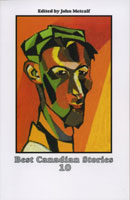
Best Canadian Stories 10

10: Best Canadian Storiesedited by John Metcalf ~ Oberon Press
  ~ Review: Halifax Herald, March 2011

“Mavis Gallant said that the one question to ask of a story, a book, a painting or a building is: ‘Is it alive or dead?’ Check this year’s vital signs,” writes John Metcalf  in the introduction to Best Canadian Stories 10.   Metcalf is right of course. Oberon’s 2010 short story collection speaks for itself.  These stories overflow with life and living and once again, Metcalf shows his ability to find the best.

Hold Me Now (Stephen Gauer) tells the story of a father who is given the shocking news that his son has been murdered.  As he attempts to make sense of it all, his life becomes linked with that of Curtis, his son’s underage killer.  Gauer’s understated tension through the ensuing trial and the events that follow is masterful. Anna (A Small Haunting by Shaena Lambert) begins to think she is quietly going mad when she finds her house is haunted by a small child. And Maude befriends a strange young girl called Kreetch (Daytrip by Patricia Young) who arrives at the library every day after school.   The gentle tenderness of Young’s story is the perfect opening to this year’s collection.

Oberon’s commitment to providing a platform for new and emerging short story writers in Canada is laudable, and this year’s collection stands with the best. Bring on Best Canadian Stories 11!

John Metcalf is a well-known Canadian author and editor.  He immigrated to Montreal from the UK as a young man.  He has been editing this collection for Oberon for many years, in the company of authors such as David Helwig and Joan Harcourt.  He lives in Ottawa.

Granta: Going Back

Granta: Going Back
Edited by John Freeman 
House of Anansi Press
  ~ Review: Halifax Herald, February 2011 

Short stories are often the first thing new writers publish.  They go in and out of popularity, and finding a home for that first story can be difficult.  Since it’s makeover in the 1970's, Granta has played a significant role in providing a market for new writers and artists, publishing short stories, photojournalism, poetry, biographies, indeed anything that is able to loosely fit within its pages.  It is indeed “The Magazine of New Writing”.

Going Back is a ‘themed’ issue based somewhat loosely on “what happens after we go back”. It diverges from Granta’s norm in that the writers and artists are well established. Editor John Freeman has put together a splendid collection of stories, poetry, art and photography about loss, memories, joy and finding the ability to let go. 

Janine di Giovanni’s The Book of the Dead brings into sharp focus the human spirit’s ability of to survive under seemingly impossible conditions of deprivation and loss during the war in Sarajevo.  Ian Teh’s stark photography of industrial China (Traces: China 1999 - 2010) speaks volumes and Missing Out by Leila Aboulela tells the story of the collision of cultural values within a marriage.  Elizabeth McCracken’s Property shows the heart of a young widower as he struggles with his loss.

There is a previously unpublished excerpt from Mark Twain’s diaries, and a series of letters written over 30 years by Iris Murdoch to French writer Raymond Queneau. (It is believed that she destroyed his letters to her.)  It is tricky to find a favourite amidst such talent.

Since its inception in Cambridge, UK, in 1889, Granta has published the works of writers such as A. A. Milne, Doris Lessing, Ian McEwan, Gabriel Garcia Marquez, Arundhati Roy and Sylvia Plath. It was rescued from oblivion in the 1970s, and the rest, as they say, is history.

The Beauty of Humanity Movement

The Beauty of Humanity Movement
by Camilla Gibb
Doubleday Canada
   ~ Review: Halifax Herald, February 2011

Maggie Ly realizes early in her life that a career in art does not need to be defined by her lack of talent.  She becomes a curator and seizes an opportunity to return to Vietnam to catalogue a collection of art which somehow survived the war in a bomb shelter.  She has her own agenda - to look for her father, a dissident artist who vanished after the fall of Saigon. 

Her search leads her to Hung, an elderly itinerant cook whose pho is legendary, and it is Hung’s story that is the heart of Camilla Gibb’s new novel.  Hung has made pho at his street cart for decades, moving from place to place, creating a daily challenge for his dedicated customers who continue seek him out, chopsticks and bowl in hand.

Through years of poverty, war and hardship, Hung has endured, changing little as the city changed around him.  In the years since the war, Hanoi has become modern, bustling tourist city brimming with energy and youth.

The importance of family and community flows through Gibbs’s novel, with the elderly Hung holding the threads which gently bind the characters to each other.  They embrace Maggie, sympathizing with her need to find the truth, to understand her beginnings so she can finally feel that she belongs.  “She had always felt herself [to be] an alien to some degree ...you have no attachment to the history or geography of a place ... your roots are buried in some faraway earth.” 

Camilla Gibb is a winner of the Trillium Book Award, the City of Toronto Book Award, and the CBC Canadian Literary Award for short fiction.  The jury of the Orange Prize listed her as one of 21 writers to watch in the new century.  She lives in Toronto.

The Paper Garden: Mrs Delany Begins Her Life’s Work at 72

by Molly Peacock ~ McClelland & Stewart
  Review: Halifax Herald, February 2011
                                   
Mary Granville Pendarves Delany was born into a minor branch of an important British family at the turn of the eighteenth century.  At the tender age of 17, this vivacious young woman was married off to a boorish drunkard old enough to be her grandfather, to improve the family fortunes.  She was widowed after seven difficult years.  She married again twenty years later, a union which afforded her much contentment and happiness, but it wasn’t until after the death of her second husband that Mrs Delany picked up scissors and paints and invented a medium now known as mixed-media collage.  She was 72.

Over the next ten years, Mrs Delany worked tirelessly at her art, creating botanically correct cut-paper flowers, precisely accurate in both detail and colour. These exquisite reproductions are often hard to recognize as paper and paint. In all, she produced 985 flowers, and it was her failing eyesight that finally stopped her.  The collection, known as Flora Delanica, is housed in the British Museum.

In The Paper Garden, Molly Peacock focuses on eleven of these extraordinary pieces of art, weaving through the narrative snippets of her own life as it parallels that of Mrs Delany’s. Her language is both visual and poetic, with an attention to detail that takes her readers into the heart of court life in eighteenth century England.

In the continuing debate about the future of print publications, McClelland & Stewart have triumphed. An electronic version of The Paper Garden would be a mere shadow, only hinting at the pleasure readers will get from this miniature art book.  The silken pages, the writing, the careful stitching, the wonderful reproductions, the subtle perfume of new ink, the size (it tucks perfectly in the corner of a bag) – these all combine to a whole that is a pleasure to hold and to read.  M & S and Molly Peacock have done Mrs Delany proud, and she would surely have been delighted.

Molly Peacock is a poet, essayist and author.  She was one of the creators of New York's Poetry in Motion program and is the Series Editor of The Best Canadian Poetry in English.  A transplanted New Yorker, she lives in Toronto.

I Am a Japanese Writer


I am a Japanese Writer
by Dany Laferriere
Douglas & McIntyre, 2010

Review: Halifax Herald, January 2011

I Am a Japanese Writer is a book about a writer who pitches a title to his publisher, takes the publisher’s advance and immediately develops writer’s block as he contemplates actually writing the book. While he waits for it to pass, he decides he must understand a little of Japanese culture.

Trolling the city for insights, he finds the self-obsessed Midori and her hangers-on, who are immersed in the decadent, ‘uber-cool’ subcultures of fashion and drugs. They amuse him. He reads haiku master Basho on the subway. He is transported. He begins to believe his artifice.  “... when I became a writer and people asked me, ‘Are you a Haitian writer, a Caribbean writer or a French-language writer?’ I answered without hesitation: I take on my reader’s nationality.  Which means that when a Japanese person reads me, I immediately become a Japanese writer.” 

When the writer announces this in a mall, the results are astounding.  The book becomes a cult phenomenon and he is suddenly an international celebrity.  He is now famous for a book not yet written. Without reality, it exists because the writer is celebrated for it and therefore it no longer matters whether or not it exists, because it has taken off and, in the words of Tom Waites, he’s “Big in Japan”, which clearly raises the question of who makes art!

Dany Laferrière was born in Haiti and immigrated to Canada in 1978.  He is the author of twenty novels, and has won several awards, including the Prix Medicis for his semi-autobiographical novel, L'Enigme du retour (The Enigma of the Return).  His first children’s book, Je suis fou de Vava, won the Governor General’s award in 2006.  He lives in Montreal. 
Translated from French by David Homel.

9 Apr 2011

Our Tragic Universe

OurTragicUniverseby Scarlett Thomas ~ Thomas Allen & Son
  Review: Halifax Herald January 2011
           
Meg is a writer, just managing to get by writing book reviews and ghost writing genre fiction for adolescents, which nets her just enough cash to buy groceries and keep her damp basement apartment slightly above freezing.

Her moody, jealous boyfriend seems oblivious to the ever rising damp and Meg’s efforts to jolly him out of his funks are met with indifference at best.  It is hard to understand what Meg sees in this sad-sack boyfriend, and when she finally makes a break for freedom from both him and the damp-infested apartment, Thomas’s reader will be thankful and slightly puzzled as to what took her so long.

A book mysteriously arrives in the mail, The Science of Living Forever, a pseudo-scientific book
about the end of time.  The very idea stops Meg in her tracks. Instead of dismissing the content as pop-psyche at best, Meg is pulled into the book’s premise.  Her‘proper’ novel morphs into a ‘storyless’ story, untidy and plot-less.

Our Tragic Universe is brimming with existential energy and philosophical debates as Meg struggles to extricate herself from her marginal existence.  Once again, Thomas explores relationships and the human condition, but these explorations are tempered by the application of the ‘storyless’ story, which does mean that the plot (or non-plot) takes place primarily in the debates of the characters.  Our Tragic Universe meanders, as was Thomas’s intention.  However, the wit and nuance of her writing hold it together, making Meg’s story sympathetic and compelling.

Scarlett Thomas is a teacher, award-winning novelist and book reviewer. In 2002, she was listed as one of the twenty best young British writers.  She teaches at the University of Kent in the UK where she specializes in the contemporary novel and narrative theory and practice.

Hooked on Canadian Books: The Good, the Better and the Best Canadian Novels since 1984

Hooked on Canadian Books: The Good, the Better, and the Best Canadian Novels Since 1984 [Book]by T. F. Rigelhof ~ Cormorant Books
  ~ Review: Halifax Herald, January 2010

“For me,” writes T. F. Rigelhof in the introduction to Hooked on Canadian Books, “reading a novel means any of at least a half dozen things, three of which are reflected in the phrase ‘good, better, and the best’.”

In this collection of reviews, essays and commentaries, the opinions expressed are unashamedly Rigelhof’s. For him, the book is “a celebration of novels written in English by Canadian writers that have made a difference in this reader’s life”.  For readers, it is a thoughtful discussion of the Canadian literary landscape in the context of individual writers and their work.  Rigelhof opens the door to discussion about the works presented and about the meat and bones of Canadian literature, and what sets it apart from, say, American literature.

Rigelhof has collected one hundred of Canada’s finest, gathering in one place a list of titles and authors who have contributed to the landscape of Canadian writing over the last twenty-five years.  “To be ‘good’ reading”, he says, “a book must insist on being read . . . A ‘better’ book makes you stop after fifty pages and start afresh ...[and] the ‘best’ novel is one that can be read over and over again ...”

This is not a book for the faint hearted. “There is blood in this book - gusto, passion, zest, good humor” and just opening it will add significantly to the lengthy list of ‘must reads’ pinned to your fridge. So many books.  So little time. You might need a taller fridge!


T. F. Rigelhof is a retired professor of literature from Montreal’s Dawson College. He is a contributing reviewer to the Globe and Mail and the author of nine previous books.  He lives in Westmount, Quebec.